

- Home
- Companies
- Raschig GmbH / Raschig USA, Inc.
- Products
- Raschig - Bubble Cap Trays
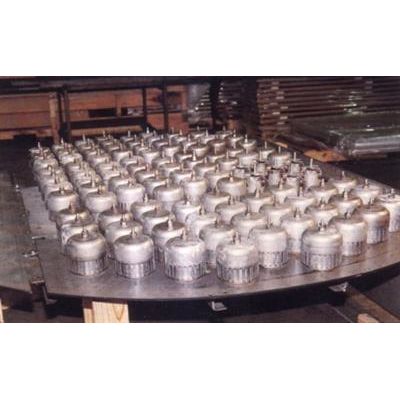
Raschig - Bubble Cap Trays
Bubble cap trays were the work horse tower internal in the first part of the twentieth century until the late 1950`s when it was superseded by sieve and valve trays. It consists of a flat perforated deck in which the holes are enclosed with vapour or gas chimney risers and caps in the form of inverted cups mounted on top of the risers. The caps can either be equipped with slots or holes, through which vapour escapes, or non-slotted where vapour is directed into the space between the bottom of the cap and tray floor (skirt clearance). Vapour is forced into the surrounding cross-flowing liquid such that aerated liquid is trapped on the tray floor to a depth at least equal to the weir height or riser height. This gives the bubble cap tray the advantage to operate at extremely low liquid and vapour rates.
The main disadvantage, besides cost, is that a large fraction of the vapour phase pressure drop is wasted as it occurs in the reversal area between the chimney riser and cap. Consequently it does not contribute to the mass transfer process.
Bubble cap trays, generally, have the ability to handle wide ranges of liquid and vapour flow rates satisfactory due to their leak proof properties. This advantage is exploited in special applications such as gas scrubbers where a large amount of vapour must be in direct contact with the low liquid flow.
Standard cap sizes of 75,100 and 150 mm are available. Custom designs are also available.