


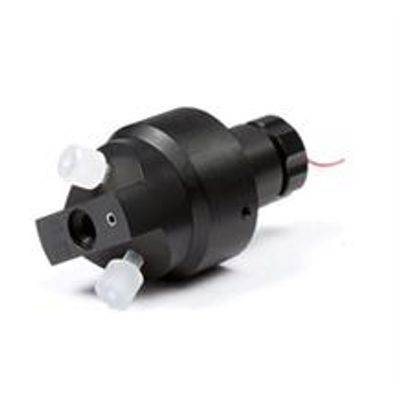
ReactorCell - Universal Flow-through Electrochemical Cell
The ReactorCell is a universal flow-through cell, ideally suited for oxidation, reduction and activation of compounds that pass through the cell. For single component analysis, the cell can be used in infusion mode by simply connecting it to a syringe pump for direct MS analysis. In case of more complex mixtures, the electrochemical cell can be positioned after HPLC separation to perform HPLC/EC/MS experiments. The ROXY system can be controlled by Dialogue software or Chromeleonn™ CDS from Thermo Fisher Scientific.
- Universal starter cell for oxidation / reduction / activation
- Virtually zero sample adsorption
- Easy electrode exchange
- Supplied with various working electrodes
Schematics ReactorCell set-up:
Direct infusion mode, i.e., EC/MS (A) and post-column separation mode, i.e., LC/EC/MS (B). Typical flow rates 5 to 20 μL/min.
The ReactorCell is based on a thin-layer flow cell concept, comprising of a very smooth working electrode surface over which the sample is flowing. This results in virtually zero sample adsorption unlike porous flow through electrodes which are prone to adsorption and carry over. The cell can be disassembled within seconds for easy cleaning of the working electrode and cell compartment.
Schematics ReactorCell with expanded view of the thin-layer flow path. The cell includes an auxiliary electrode block with inlet/outlet (top), working electrode (bottom) and 50 µm spacer, volume approx. 0.7 μL.
The ReactorCell is supplied with 4 working electrodes, Pt, Au, Glassy Carbon (GC), and Magic Diamond (BDD), which can be quickly and easily exchanged. GC is the workhorse and electrode of choice for oxidation reactions up to 2 V. For voltages > 2V, BDD a conductive diamond electrode is recommended as it can be used up to 4V. Pt and Au are typically employed for specific reactions such as hydroxylation or N-oxidation.
Working electrode holder (assembly) with supplied electrodes: Pt, AU, GC and BDD (left to right).