


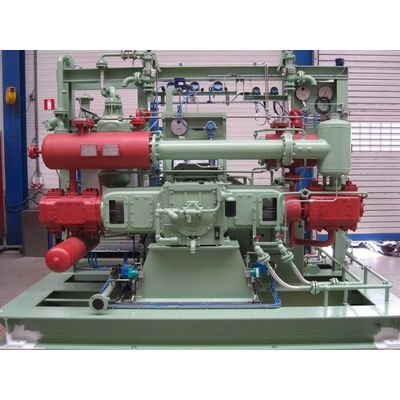
Reciprocating Compressors
We offer a complete range of oil-lubricated and oil-free air and gas compressors suitable for any application and environment. All our products can be customized to your specifications and requirements. We are free to choose any compressor brand upon your request or best suitability for the application. Airpack reciprocating type compressor packages are capable of continuous duty with low levels of maintenance and are suitable for high temperature environments. Our reciprocating compressors can be delivered in different setups: horizontal, vertical or V-type. Depending on the application and available space we can help you decide which type would be best suitable for your request. Reciprocating compressors are available in a wide range of capacities and can go up to very high pressures. The range of each compressor type can be found here. Do you need to go higher in capacity or pressure? Check out our centrifugal compressor or contact our sales team, they are ready to help you find your solution!
- Easy and low maintenance level
- Low noise frequency
- Suitable for high temperature environments and high pressures
- Suitable for earthquake areas
- Available in oil-lubricated and oil-free
- All compressor brands are possible
In highly developed countries. ready and abundant supplies of energy — for heat, electricity and fuel — are essential to the conduct of commerce and quality of life. This is why expansive infrastructure networks spread across the United States and other economically advanced nation-states. These chains consist of extraction sites, pipelines, refineries, processing facilities and storage repositories. Conveying natural gas and biogas, for instance, through these systems at a reasonable tempo and in sufficient quantity requires reducing the volume under normal atmospheric conditions. Key to this task is the employment of a gas compressor at various points in the supply chain.
A compressor is an instrument that condenses natural gas so that its volume is constricted to a fraction of what it was pre-compression, i.e. under standard atmospheric pressure. It crunches the gas molecules so they occupy less space. At the same time, the number of molecules remains constant. Just as suitcase contents can be re-arranged to fit more in by eliminating space between articles, gas compression puts molecules closer together so more gas can fit in pipelines and storage tanks. This procedure applies the Ideal Gas Law — pressure x volume = number of moles x universal gas constant x temperature. In short, increasing pressure reduces volume.