- Home
- Companies
- PASI s.r.l.
- Products
- PASI - Model POLARES32 - Resistivity ...
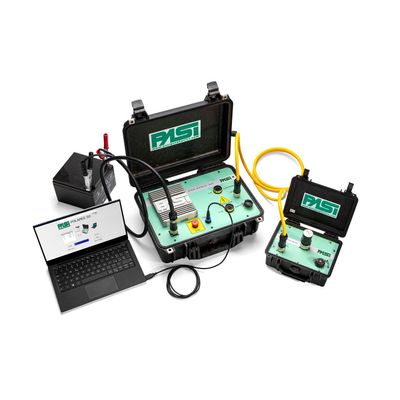
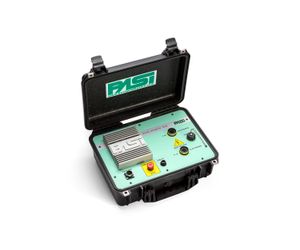
PASI - Model POLARES32 -Resistivity Meter with Multi Electrodes - EARTH RESISTIVITY - IDENTIFICATION OF KARST CAVES, BURIED OBJECTS, MONITORING OF POLLUTANT DISPERSION, SALT
- Voltage, current, power that can be generated: 700 Vpp, 2 A, 200 W
- Converters: 24 bits, Sigma-Delta
- Voltage measuring range: 300V, 6V
- Current measuring range: 3A
- Sinusoidal Frequencies that can be generated : 125Hz, 62.5Hz, 31.2Hz, 15.6Hz, 7.8Hz
- Measure quality test: Continuous component, distortion, background noise, exceeding phase, sigma module, sigma phase
Maximum number of electrodes: unlimited - Maximum number of scans per measurement: unlimited
- Power supply: Pb or Lithium External battery, 8.5V= / 15V=; 30A internal fuse, protection against polarity inversion
- Dimensions and weight: 406x335x174mm; 7.2kg (main unit)
- Shallow detailed investigations of pollutant plums in the ground
- Archeological surveys
- Waste site doposit monitoring
- Mapping and monitoring of salty water contamination of groundwater reservoirs
Electrical imaging applied to geophysical exploration has been using the same traditional method for acquiring data of the traditional VES soundings with 4 electrodes: an electric current was applied between two electrodes and the correspondent voltage was measured between other two electrodes inserted in the ground. Applied current and the related voltage were always continuous, with an inversion of polarity for each measurement. POLARES32 uses a sinusoidal alternate current of variable frequency. Even if the instrument designing could be more complicated, the use of alternate current had shown great vantages, in particular considering the absolutely greater velocity of acquisitions, that may increase of at least 10 times in respect of standard DC measuring time. Moreover, the measurement of the ratio between Voltage and Current can be done in a sinusoidal condition for both module and phase (delay of a signal in respect of the other); these two information obtainable with a single measurement, allow the system to acquire both resistivity and IP data.
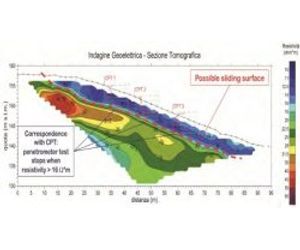
The survey purpose was to identify the lithology of the ground in a building area, in addition and support of Static Penetrometer Tests and Vs30 seismic profiles made on the same line. The high resolution survey with 48 electrodes with 2m spacing (total length 94 m), made using Wenner- Schluberger method, reached a medium exploration depth of approx.15 m from the surface.
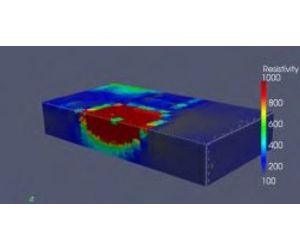
3D Resistivity profiles, test site CNR (National Research Center) Torino. Sandpit surrounded by a coarse-grained silty-sandy soil type.
The site shows a net anomaly of resistivity, since the high permeability of the sand with which is filled the tank causes the latter is in a condition of minimum saturation (especially during the dry season, in which was made the survey) compared to the surrounding soil.
POLARES32 electrical imaging system for tomography makes use of innovative technology based on Alternate Current (AC) to simultaneously measure and display all survey parameters: soil resistivity, current, voltage, self potential, induced polarization and quality of the measurements.
Compact-sized, simple and intuitive, it easily manages all multi-electrode array configurations for the measurement of apparent resistivity: Schlumberger, Wenner, Dipole-Dipole and any other User defined 4-poles configurations.
Equipped with an automatic “multiplexer” to commute signals on the different electrodes, the instrument can measure both current and voltage with microprocessor-controlled sequence of measurements.
The acquisition controlling system, the power section and the multiplexers for the first 32 electrodes are now integrated in the main unit.
POLARES32 works connected with external laptop PC (to be supplied by the End User); with its data acquisition software supplied with the instrument - with free upgrades for the whole lifetime of the instrument - it has been designed to be a very flexible ERT system, easy to use and with top-level performances.
The simple and intuitive data acquisition software allows you to test all the electrodes, quickly set all the acquisition parameters, manage the type of spreading chosen, always have the measurements under control and save the acquisitions directly in your project directory.
The 12V battery used to energize the ground remains external (not included in the supply, as it is easily available everywhere), together with the signal switching system for each set of 16 electrodes in addition to the first 32 (e.g. the 48-electrode system includes 1x external MPX).