

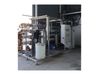
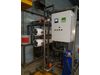
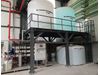
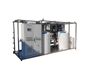
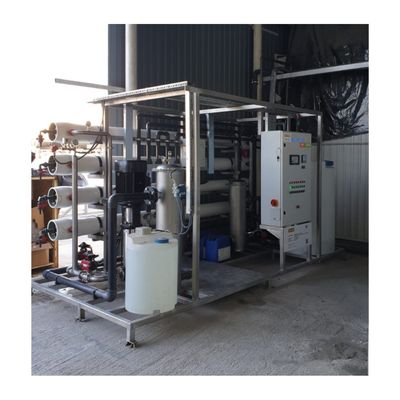
EPA CEVRE - Reverse Osmosis System
Today, access to clean drinking and utility water is of great importance for both individual health and environmental sustainability. Contaminants such as chlorine, heavy metals, microorganisms, etc. that pollute raw water must be removed. Reverse osmosis (RO) technology is one of the most effective technologies used to remove contaminants.
Osmosis is a natural process that has been known for thousands of years and forms the basis of Reverse Osmosis. Living cell walls are naturally semi-permeable membranes. For example, a high amount of water outside the cell membrane passes through the membrane and attempts to equalise the concentration and pressure on both sides of the membrane. Due to the semi-permeable nature of the membrane, the passage of water is easier than the passage of dissolved minerals. Water in a less concentrated solution seeks to dilute the more concentrated solution. A concentration difference arises between the two solutions, determining the osmotic pressure difference. When pressure is applied to the concentrated solution with the higher osmotic pressure, the flow of water reverses, and RO is established.
Water containing dissolved salts and small particles is forced through reverse osmosis membranes at high pressure. While water molecules pass through the pores of the membranes, dissolved salts, organic matter, heavy metals and bacteria cannot pass through the membranes. These substances that cannot pass through the membranes are discharged as concentrated waste. The most important parameter in water to be treated with RO is undoubtedly the TDS (Total Dissolved Solids) value. TDS provides clear information about the characteristics of the raw water used. All RO systems operate on the same principle. Filtration occurs as the feed stream passes through the membrane, and minerals are removed and discarded as water passes through the membrane.
Primary applications:
- Process water preparation systems
- Drinking water production,
- Production of utility water,
- Demineralised water production
- Boiler feed water preparation systems
- Ultra-pure water production
- In obtaining pure water for haemodialysis units
- In fruit juice production
- Production of drinking water from seawater.
- Wastewater recovery systems
- Can remove up to 99% of dissolved salts and contaminants from water.
- Generally requires fewer chemicals compared to other treatment methods.
- It can continuously produce water at a high capacity to meet large industrial demands.
- RO devices offer efficient and reliable water treatment solutions that are critical in many industries today.