


- Home
- Companies
- TA Instruments -Waters Corporation
- Products
- TA Instruments - Model ARES-G2 - ...
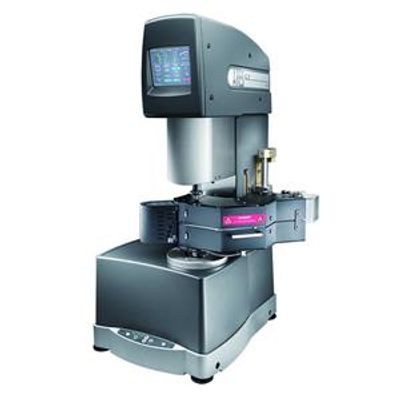
TA Instruments - Model ARES-G2 -Rheometer
The ARES-G2 is the most advanced rotational rheometer for research and material development. Rheology is the study of flow and deformation of materials under the influence of an external force or stress. The combination of stress, strain and shear behavior forms the basis of rheology, the science of the deformation of materials. Rheology measurements are used to ensure successful material processing, optimize product performance, gain insights into complex microstructures and develop novel materials.
The ARES-G2 platform offers an array of features including:
- Unrivaled data accuracy over a wide range of conditions simulating processing and end-use conditions
- Only rheometer with true SMT technology that completely eliminates inertia, even under the most challenging conditions
- Accurate and fast-responding temperature control
- Complete data transparency and control with access to raw data that can be plotted in TRIOS or easily exported for processing in third-party software
- Future proof with fully integrated DMA mode for solids testing (bending, tension, compression) and advanced techniques such as:
-
- Arbitrary wave
- Large Amplitude Oscillatory Shear (LAOS)
- Fourier Transform (FT) Rheology Analysis
- Orthogonal Superposition (OSP) and 2 Dimensional Small Amplitude Oscillatory Shear (2D-SAOS) techniques
- Optimally windowed-chirp (OWCh)
-
and much more…
Force/Torque Rebalance Transducer (Sample Stress)
- Transducer Type: Force/Torque Rebalance
- Transducer Torque Motor: Brushless DC
- Transducer Normal/Axial Motor: Brushless DC
- Minimum Transducer Torque in Oscillation: 0.05 µN.m
- Minimum Transducer Torque in Steady Shear: 0.1 µN.m
- Maximum Transducer Torque: 200 mN.m
- Transducer Torque Resolution: 1 nN.m
- Transducer Normal/Axial Force Range: 0.001 to 20 N
- Transducer Bearing: Groove Compensated Air
An accurate mechanical measurement is based on the fundamental assumption of a controlled variable (stimulation) and a measured variable (response). The separation of these key experimental quantities guarantees the greatest accuracy. Moreover, the analytical components dedicated to each task should be optimized to their assigned role. In the case of a modulus measurement, the application of strain and the measurement of stress should be separated, or in the case of a viscosity measurement, the application of strain rate and the measurement of stress are to be decoupled.This is the approach taken by the TA Instruments ARES-G2, leading to measurements free of instrument artifacts over wide ranges of stress, strain, and frequency.