


- Home
- Companies
- Anthony Hardwood Composites, Inc.
- Products
- Emtek - Rig Mats
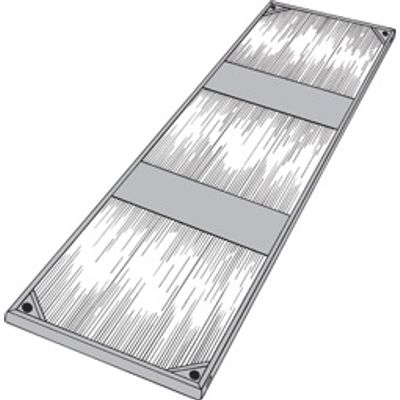
Emtek - Rig Mats
This Design Guide is intended to provide design information to enable you to determine how emtek rigmat can best serve your needs. Anthony Hardwood Composites’ emtek rigmat is an engineered, laminated wood mat that is made from indigenous Southern hardwoods in Sheridan, Arkansas and then framed with a 1/2″ wall formed channel. By protecting the emtek core from handling abuse, the emtek rigmat will provide longer and more consistent usable mat life.
emtek rigmat is engineered to withstand the abuse of today’s industrial construction sites. Control of raw material density in the manufacturing process ensures that emtek rigmat has a hard, impact resistant surface. The laminating process creates a composite structure that resists fracture.
StrengthPredictable, reliable strength is a necessity when the safety of workers and equipment assets are at stake. Patented construction creates a work platform that has engineering design values that exceed all sawn woods identified by the National Design Standard (NDS 2004). Every emtek rigmat component is proof loaded by machine to ensure that the finished mat will meet the strict design criteria and quality standards established by AHC.
ConsistencyUniform product dimensions with a consistent finish create a work surface that helps contractors reduce workplace hazards.
emtek rig mats are valuable to the contractor, and proper storage can extend the service life for many years. Product should be stored in an environment with good drainage. Stacking mats with stickers between layers provides an avenue for air movement that can reduce the effects of decay caused by prolonged exposure to moisture.
Wood is a natural polymer that exhibits good resistance to chemical exposure; however, extended contact with strong acids (ph<3) or strong bases (ph>9) can cause wood to degrade and compromise the structural integrity of the product. The resins used in emtek rigmat construction are thermoset polymers that are highly resistant to chemical attack and will degrade slower than the wood when exposed to high chemical concentrations. Chemical MSDS sheets should be referenced if the product’s exposure is suspected.
Prolonged exposure to temperature above 150° F can cause the wood to degrade and should be avoided to ensure that the product performs at the designed levels.
emtek rigmat mats are essentially our standard emtek mat framed with steel for added durability. Like our standard emtek mats these are engineered to support specified loads. The tables in this guide show allowable loads. These loads are based solely on the strength of the emtek billets within the frame. No strength has been associated with the steel frame in the following allowable load tables. This is because the distance between steel members is too great to assume that loads can be effectively transferred from one steel member to the next with a moving load. Each rig mat has been proof loaded to 1.5 times the allowable load at the manufacturing facility to certify these values.
The following pages show different loading configurations for the mats. Mat thickness is actually 1/2″ greater than the indicated size. This is because machining the emtek billets to accept the steel and create a flush surface results in an affective loss of material of 1/2″. Generally pneumatic tired vehicles will be represented by the 6′ wide loading configurations (Load Case 1 and Load Case 4). Tracked vehicles will generally be represented by the 9′ wide loading configurations (Load Case 2 and Load Case 5). When one wheel or track is on one mat, the single load configurations shown in Load Case 3 and Load Case 6 will be applicable. In all cases the loads shown in the tables are in thousands of pounds (Kips). To get pounds simply multiply the number in the cell by 1000.
It is important to note that the loads are associated with one foot of mat width. If the footprint of the tire is 2′ long then the allowable load can be multiplied by two. This is especially important when considering applications for tracked vehicles that can distribute loads along track lengths up to16′ or longer.
There are two sets of tables. The first set is for applications where load is centered on the mat. The second set (Table 2) is for applications where the load is offcenter. In the applications of Uniform Bearing, we have shown different allowable loads for different soil conditions (Soil Type “1”, “3”, and “5”). These soil conditions are described in the notes on page 7 of the tables. It is important to choose the soil condition that most closely approximates the conditions that will be supporting the rig mats, as this will affect the allowable loads.
The tables show different deflection preferences. If you would like to see no more than 2″ of deflection on the matted surface the lower rows of each mat size should be considered. If a deflection up to 4″ is acceptable, then upper rows and the associated higher loads can be considered. In some cases loads are limited by the strength of the product, and maximum deflections are not allowed. In this case the deflection at the maximum allowable load is indicated.
Certainly construction applications with heavy equipment will result in unique loads and loading configurations. If you have any questions regarding your unique situation please feel free to call us at 870-942-4000.
The design properties and strength characteristics of the emtek product are verified at the time of manufacture. During the service life of the product, use conditions will reduce the load carrying capacity of the product. If there are any questions as to whether the strength of the product has been compromised during handling, storage, aggressive use, etc., please feel free to contact us so we can help assess any potential degrade.