

Zetas - River Water Treatment System
Pre-Chlorination: In order to provide treatment in WHO (World Health Organization) standards, it is necessary to pre-chlorinate before sedimentation or filtration.
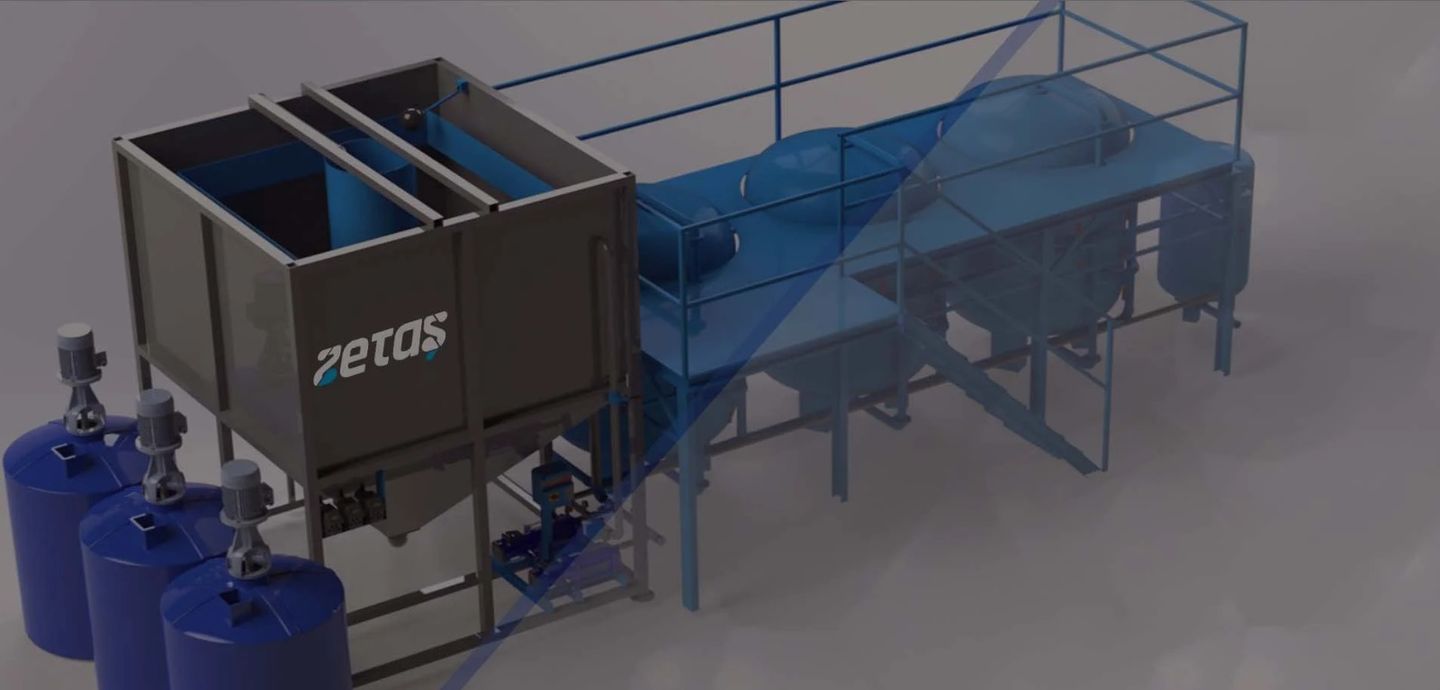
- System design is established with the principle of physical and chemical treatment.
- There are 2 standard designs in total. These are 50 m3/hour and 100 m3/hour. For higher capacities, multiple system designs are made by our professional team.
- It provides 10 times more precipitation than traditional methods. Plates are placed at an angle of 55 degrees for optimum precipitation.
- PVC plates are submerged in water and are resistant to corrosion.
- It reduces operating costs thanks to non-moving parts and self-cleaning plates.
- The floor covering rate is much less than other systems. For this reason, it provides a very efficient usage area.
- In Iraq, water from rivers or other springs is used to produce domestic quality water.
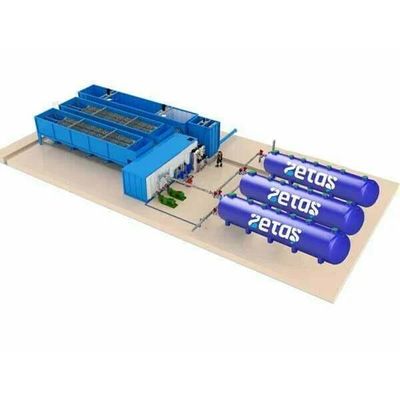
- Compact treatment systems consisting of pre-chlorination, coagulation-flocculation, lamella treatment sand filtration and chlorination units are a very ideal process for suspended solids removal.
Coagulation-Floculation: Purpose; is to separate the fine particles from the water components that cause turbulence and cause the formation of stable colloids.
Lamella Treatment: Treatment of water after chemical treatment is usually done by precipitation. Lamella is used to reduce the settling area. Lamella precipitation, unlike the others, provides high precipitation at low surface. After the settling process, the purified water is transferred to the storage tank and sent to the sand filters with horizontal centrifugal pumps under pressure.
Sand Filter: Purpose; It makes clean water ready for use by separating the remaining parts and flocs that are not removed by the precipitation process.
Disinfection (Final Chlorination): By making final chlorination, it is ensured that there is no bacteriological pollution in the treated water.
One of our natural water resources is our rivers. It is possible to obtain clean water with river water purification . In fact, river waters are a rather hard and mossy type of water. That`s why it can cause a lot of trouble in pure use, it needs to go through a deep purification process. First of all, sand, stone and similar substances in the river water are separated. After this stage, chemical disinfection is carried out against the bacteria in the water. Conversion of river water is somewhat cumbersome. After these two processes, settling and filtering are provided in order to prevent suspended objects in the water. Lime is supplemented with softeners to dissolve the lime in the water. Especially in order to completely clean the algae in the water, it is subjected to the precipitation process again.
In order to use the river water, the purification system is intertwined with strong connections. In order for the turbidity in the water to be clear and transparent, the water passes through the granular filters again. The taste of the water is balanced by separating the salt ions in the water with reverse osmosis. In the last stage, the purity level of the water is adjusted with the EDI process. Thus, the river water becomes ready for use.
Making use of water treatment in order for the water to be of better quality and safe before use is a move that benefits both human health and nature. As of today, it is possible to treat almost any type of water easily. Water purification systems, which safely purify every water from natural water sources to waste water, are creating miracles with the ever-developing technology. Water is a liquid that we have to use in almost every moment of our lives. There is nothing that can take its place. However, as a result of the wasteful behavior of human beings, our waters are polluted with wastewater and become unusable. The real danger is the impending drought.
Thanks to water purification, it is possible to use water that we never thought to use, such as sea water, streams, and streams. Treatment water can be used individually as well as to meet the water needs of the community. In times of disaster, the water needs of barracks, schools, hospitals and industrial business areas can be easily met thanks to treatment. In general, the restriction of water needs in crowded communities leads to very unhealthy results. However, with the treatment, the continuous flow of water is ensured and health conditions are guaranteed. Of course, the purification devices used in homes and workplaces are very diverse, independently of each other. It is very correct to be guided by consulting the experts about what kind of water is desired to be purified according to the need. decide on your own,
As we can purify the water we drink and use, it is a system that must be present in facilities, especially in factories. Since the mixing of waste water with nature will be a big problem, first of all, purification is necessary for a healthy world. Treatment is also a source of savings that allows recycling. Savings made from water is a step taken to protect our future. That`s why it`s everyone`s human duty to support production without focusing on consumption.
Reverse osmosis is a type of purification known as reverse osmosis . It has a very strong effect as this system used in the exchange of physically and chemically undesirable ions in water. This type of purification is provided by pressure. Especially in water, it is very useful in the purification of objects that are already present but invisible to the eye. Reverse OsmosisThanks to the purification, both drinking water is obtained and water to be used in industry as a contribution to production is provided. This purification provides function with two basic steps. It has a very important effect on the hot water treatment system. The water with a high temperature is partially cleaned by passing through the filters, leaving undesirable substances such as sand, stone and dust behind. In this way, the purification passes to the second stage. The water pumped with pressure is cleaned by passing through the membranes. Here we need to mention an important cleaning power. The water passing through the membranes also has the function of destroying the heavy metals formed in the water.
Since it is a highly effective system, Reverse Osmosis is known as the most used purification system. It also provides a source of savings as it enables the use of all kinds of water very easily. For example, while it is impossible to drink sea water in its pure form, it is possible to drink it thanks to purification. Sea water, which is presented as purified and cleaned, is now just water. There is a powerful transformation here. It works wonders in filtration and pressure purification. All kinds of effects that may harm human health, such as bacteria and microbes that may occur in water, are reduced to zero.
The Reverse Osmosis treatment system has a wide range of uses. Especially in industrial factories, thanks to this system, it is possible to convert water to its purest form without using a single chemical. The water is purified almost by multiplying. Being able to purify thousands of cubic meters of water with one treatment is a great saving. In addition, the system provides a warehouse function by itself. Therefore, it also provides economic benefits without the need for an extra warehouse. In order to use this system, it would be a very appropriate behavior to consult the experts who provide treatment beforehand. Because every treatment may not be suitable for every area. In addition, it is very important to make the necessary adjustments by experts in order to get healthy efficiency from the treatment. Otherwise, the water may be damaged by excessive purification.