


- Home
- Companies
- Edinburgh Instruments - TECHCOMP Group
- Products
- Edinburgh Instruments - RMS1000 Raman ...
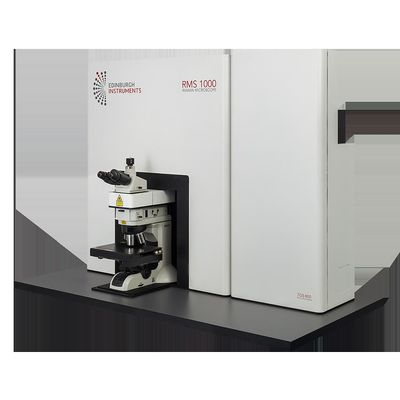
Edinburgh Instruments - RMS1000 Raman Microscope
The RMS1000 is an open architecture research grade confocal Raman microscope. It has been designed so it can be adapted to almost any modern, state-of-the-art Raman application.The RMS1000 Raman microscope is an open architecture research grade confocal Raman microscope. It has been designed so it can be adapted to almost any modern, state-of-the-art Raman application. This high-end research tool has been built with no compromises, resulting in a system that stands alone in both specification and ease of use.
Truly Confocal – multiple position pinhole for high spatial resolution, fluorescence and background rejection and application optimisation
Five-Position Grating Turrets – for unrivalled spectral resolution from 0.1 cm-1 and coverage over 5 cm-1 – 30,000 cm-1
Two Spectrograph Options – standard compact and long focal length spectrographs available for ultimate resolution, sensitivity, and stray light rejection
Four Simultaneous Detectors – up to 4 detectors can be installed, including high efficiency TE-cooled CCDs, EMCCDs, InGaAs and more
Photoluminescence Microscopy, Time-Resolved Measurements, Fluorescence Lifetime Imaging (FLIM) – extend the Raman capabilities to fluorescence and beyond
The open architecture design of the RMS1000 offers a versatile and customisable laser beam path and a maximum choice of lasers. Once configured, all hardware selections and measurement options are fully automated.
- Up to 5 fully integrated lasers of compact design
- Multiple external lasers of larger footprint
- Accurate laser power attenuation
- Laser line rejection filters with excellent performance, allowing for low wavenumber measurements
- Fully software controlled operation, no manual switching of sources and optical components
RAMACLE® SOFTWARE
Ramacle is an exceptional software package written for complete instrument control and data handling on the RM5 system. Ramacle controls all RM5 functions with a straightforward design concept. It focuses on all modern Raman spectroscopy applications, while at the same time, providing a user-friendly interface with ‘ready to publish’ outputs.
The software provides control, visualisation, data acquisition, analysis and presentation of the RM5 whether it is used for generating Raman spectra or with advanced upgrades such as Raman mapping.
Ramacle enables sample visualisation, live signal monitoring and parameter optimisation before every measurement. The instrument status and signal are displayed and constantly updated during measurements.
Data generated by Ramacle have a proprietary file format. This contains all measurement and instrumental properties, allowing the user to retrieve important information whenever needed and ensures data traceability. Simple input and output functions provide the required compatibility with third party data analysis or presentation packages.
KnowItAllTM Raman Identification Pro spectral library is available for material identification and advanced analysis. Data acquisition methods such as single measurements, multiple and accumulated scans, kinetic scans and generation of maps (accessory dependent) are implemented by intuitive and in user-friendly wizards.
Ramacle Key Features
- Selection of laser and scatter optical pathways
- Selection of excitation wavelength, gratings and exposure time
- Sample and laser focus visualisation
- Programmed attenuator and shutter
- Single, accumulated and kinetic spectral acquisitions
- Spectral correction
- Selection and scans of internal calibration standards and automated calibration correction
- Data operations such as arithmetic, scaling, normalisation and baseline subtraction
- Cosmic ray removal, cropping, smoothing
- Automated laser alignment
- ASCII / CSV data import / export function
- Paste options for presentations and publications
- Mapping features – map setup, collection and data analysis
- Fully motorised stage – XYZ control through joystick and software
- Polariser and analyser selection and control
- Detectors selection
- Laser rejection filter selection
- External camera selection and visualisation