


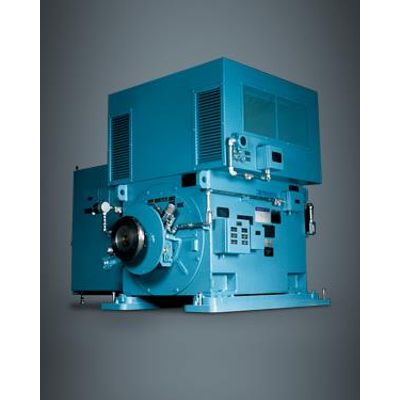
Rock - Model 541 -Petroleum / Chemical Motors
Each year brings a new and stronger challenge to the petroleum and chemical industries to be more competitive. TECO-Westinghouse recognizes motors are a significant part of the competitive solution. The petroleum and chemical industries require efficient, reliable, and life cycle cost effective motors and generators.
The TECO-Westinghouse Rock 541™ Motor meets these challenges.
The Rock 541™ is a motor custom designed for your specific application requirements. It combines features developed during 100+ years of experience with the latest design technology. The Rock 541™ Motor can meet or exceed the most demanding specifications. The Rock 541™ Motor can meet the lowest vibration requirements, and is available in all API 541 configurations. It provides you with state of the art technology and performance and, just as importantly, keeps you within budget.
TECO-Westinghouse utilizes the latest design and management tools to produce the Rock 541™ Motor to the highest quality standards. Systems that support concurrent engineering, 3D solids modeling, and finite element analysis are employed. These engineering tools are coupled to one of the most advanced product data management programs to insure product integrity.
Whatever your requirements, the TECO-Westinghouse stands ready to assist you in developing a solution.
For Unequalled Dielectric Strength and Voltage Endurance
Thermalastic® is a proprietary, integrated insulation system that impregnates the wound and connected stator with a solventless epoxy resin. Developed by Westinghouse over 40 years ago, Thermalastic® is acknowledged as the industry’s premier insulation system and is under continuous development to maintain its position as the world’s finest.
Mica is the heart of the Thermalastic® insulation system and is applied to all of the stator coils. The form-wound stator is postimpregnated with epoxy resin in a vacuum pressure tank and then transferred to an oven for polymerization. The cycle is repeated to ensure elimination of corona generating voids. The result is a stator insulation system that withstands prolonged voltage stresses moisture, dirt, thermal cycling and chemical contaminants.