
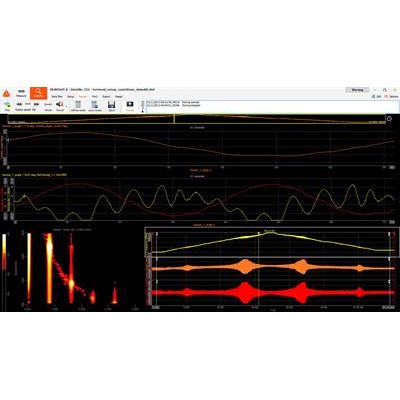
DEWESoft - Rotational and Torsional Vibrations
Torsional vibrations are quite often a source of issues and faults on the long shafts. Rotational and torsional vibration module along with order tracking is a perfect tool to troubleshoot such issues in automotive, industrial or power-generation applications.
- EASY SENSOR SETUP: math module supports any type of sensors. Sensors type can be totally different for both ends of the rotor. SuperCounter technology provides 10 nsec resolution of determining rotational angle and speed.
- ACCESS TO ALL DATA: all data, such as reference angle, individual sensor rotational angle, speeds and acceleration, torsional angle and velocity are readily available for advanced analysis
- ADVANCED MATH: different input filters and rotational DC filters are available as well as a chance to enter rotational speed ratio for gearbox analysis;
- ORDER TRACKING INTEGRATION: closely combined with order tracking, advanced data analysis is available based on same angle sensors as the source of frequency
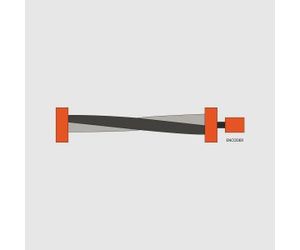
Torsional vibrations are angular vibrations of an object, typically a shaft along its axis of rotation. Torsional vibrations are evaluated as the variation of rotational speed within a rotation cycle. RPM variations are typically induced by a rough driving torque or a varying load.
Rotational vibration is simply the dynamic component of the rotational speed. If we measure the rotational speed of the shaft with high precision, we will notice that we get a high deviation of rotational speed in some regions of the run-up. This is caused by the angular vibration crossing the angular natural frequency of the shaft. It is calculated by cutting off the DC component of the rotational speed or the rotation angle
The level of torsional vibration is influenced by a number of parameters, such as material properties, operating conditions (such as temperature, load, RPM, etc.).
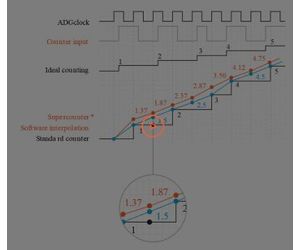
Dewesoft data acquisition systems utilize a patented and registered trademark technology called SUPERCOUNTER®.
Counter inputs can measure RPM and angle of rotating machines. In comparison to standard counters, which only output integer numbers one sample later (e.g. 1, 1, 2, 2, 3, 4), SUPERCOUNTERs® are able to extract the accurate values like 1.37, 1.87, 2.37, etc. fully synchronized for time and amplitude. This is done by measuring the exact time of the rising edge of the signal with an additional counter. Our SUPERCOUNTERs® work on a 102.4 MHz time base, independent from the current sampling rate.
Counter inputs are fully synchronized with analog, CAN bus, and other data sources to enable easy applications like balancing, order tracking, and torsional vibrations.
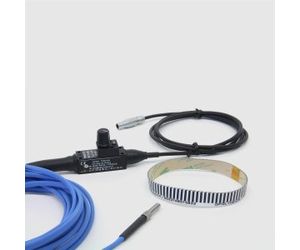
Torsional and rotational vibration can be measured with either an encoder (up to 3600 pulses per revolution) or a special sensor (CA-RIE-360/720) that has a lower resolution (up to 720 pulses per revolution) but is much less sensitive to vibrations that could damage standard encoders.
Some very typical sensors are predefined. However, if your type is not listed, you can define your own sensor in the Counter sensor editor. Note, that for torsional vibration module the sensor has to be either an Encoder or a CDM type.
The input filter is needed to prevent glitches and spikes in digital encoder pulse signal. It can be set from 100ns to 5us, the optimal setting is calculated.
The rotational DC filter needs to be set to cut the DC component of the RPMs. We need to set the filter to include all wanted frequencies, but not too low, or else we will have static DC deviations on the output signal. It can be set from 0.1 to 10 Hz. You have to ensure that your lowest RPM is not filtered out!
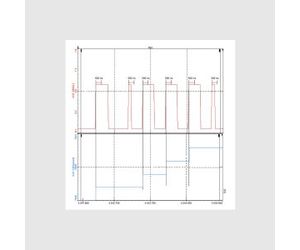
Dewesoft X torsional vibration module automatically calculated several different parameters:
- Rotational angle: Filtered angle value of vibration.
- Rotational velocity: Filtered velocity vibration value.
- Torsional angle: the Dynamic torsional angle that is the angle difference from sensor 1 to sensor 2.
- Torsional velocity: Difference in angular velocity from sensor 1 to sensor 2.
- X-axis reference angle: The reference angle, which is always from 0 to 360 and can be used as a reference in angle based XY diagrams.
- Frequency: In RPM units.
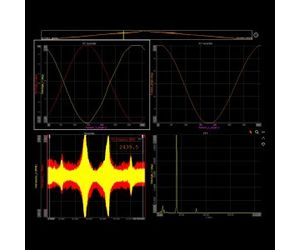
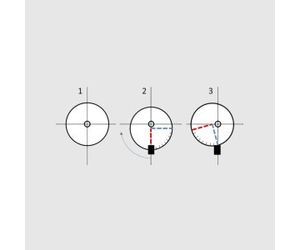
Centered mounting is very important. Off-center mounting and unsteady pulses from the encoder can be compensated in Dewesoft X using the reference curve.
However, it is required that the load must be removed from the engine - it must be free-running. Otherwise, you would also cancel out vibrations you want to analyze. When the machine is running at idle speed with no real torsional vibration, press the “Set” button.
You can learn more about FFT analysis at Dewesoft PRO online training by navigating to the Rotational and Torsional Vibration PRO training course.
Dewesoft PRO training is a free online training for measurement professionals. Learn how to measure signals, data processing and how to use Dewesoft products. Online PRO training is completely free.