
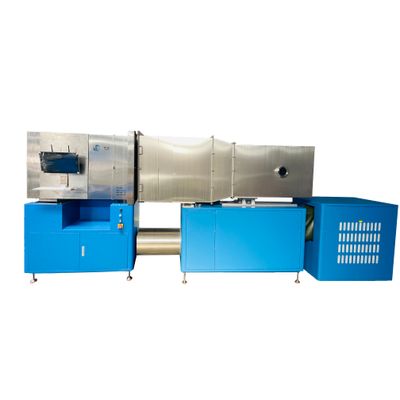
SCINCE - Model SC-7099 -Air Filtration PerformanceTest System
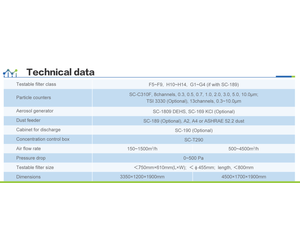
Multi-Standard Compliance: Supports ISO 16890, EN 779, ASHRAE 52.2, ISO 29463, and EN 1822-5. Flexible configurations for testing various filter types, including filtration efficiency, resistance, and dust holding capacity.
Versatile Testing Capability: Capable of testing multiple filter types, such as bag, panel, V-bank, and cylindrical filters.
Remote Troubleshooting: Provides remote diagnostics and calibration for convenient user support.
Quality control of coarse, medium, fine, EPA, and HEPA filters.
Testing of general ventilation air filters, including panel filters, V-bank filters, box filters, bag filters, cylinder filters, throwaway filters, washable filters, and electrostatic filters.
Air filters in the following settings can be tested:
Residential and commercial buildings
Industrial workplaces Hospital inpatient care
General surgery Laboratories
Cleanrooms Smoking lounges
Paint booth inlet air
Filters are mounted on rotatable duct sections. Air passes through a HEPA filter and mixes with aerosol.
Two particle counters measure particle levels before and after the filter. Data is sent to the control system for calculating filtration efficiency.
A pressure sensor monitors the pressure difference, while a dust feeder assesses dust holding capacity.
Results evaluate resistance, dust holding capacity, efficiency at various loads, and average efficiency for filter classification.
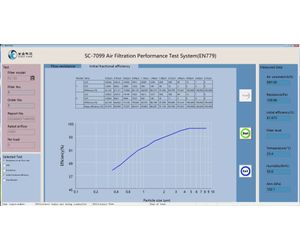
Standard Processes: Built-in testing procedures for various product standards tailored to customer requirements.
Automated Detection: Automatically checks concentration and airflow; tests commence once conditions are met.
One-Click Operation: Easily execute tests by selecting standards and items.
Real-Time Results: Live display of filtration efficiency and resistance changes.
Alarm System: Multiple alarms and prompts minimize manual judgment.
Guided Testing: System prompts assist with dust holding capacity tests, automatically recording data.
Visual Data: Clear graphical presentation of results.
Database Management: Regular backups for historical data with automatic pass/fail classification.