
- Transform traditional dynamic seal into static sealing and therefore achieve zero leakage transmission of power.
- Transmission of vibration can be avoided, then realize stable running of equipment with non-contact transmission.
- Release over-load protection.
- Simple structure, easy to assemble, debug and maintain.
- Different movement forms are available includes linear movement, rotational movement, or screw composite motion.
- Eliminate pollution.


SDM Magnetics Co., Ltd.
- Home
- Companies
- SDM Magnetics Co., Ltd.
- Products
- SDM Magnetics - Magnetic Coupling
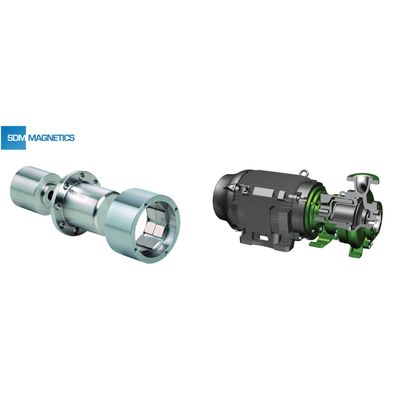
SDM Magnetics - Magnetic Coupling
Magnetic coupling is a technique utilizing the force between opposite magnetic poles to enable non-contact transmission between mechanical systems, characterized by the absence of friction and noise. This method involves components like the outer rotor, inner rotor, and an isolation shell made of permanent magnets, soft magnetic materials, and magnetic shielding materials. The chosen magnets must have high remanence for ideal torque, intrinsic coercivity to resist demagnetization, and stability under varying thermal conditions. The magnetic shielding material also plays a role in reducing permeability and protecting against corrosion to ensure effective magnetic flux flow between poles. Additionally, the inner and outer rotor assemblies require high permeability soft magnetic material to complete the magnetic circuit, and any alterations to these structural parameters can substantially affect torque transmission efficiency.Most popular related searches
Magnetic coupling has different classification criteria:
- Can be classified to synchronous type, eddy current type, and hysteretic type based on coupling principle.
- Can be divided into linear type, rotational type, and screw type according to movement form.
- Can be classified as cylinder type and disc type on the base of the structural form.
- Can be fell into intermittently type and combined type as per arrangement of magnet.
Magnetic coupling are mainly consisted of outer rotor, inner rotor, and isolation shell which involves permanent magnet, soft magnetic material, and magnetic shielding material.
Magnets for coupling should possess high enough remanence to provide ideal torque, high enough intrinsic coercivity to prevent demagnetization, and favorable thermal stability. The main function of magnetic shielding material is support and protect the permanent magnet, and magnetic shielding is secondary. Magnetic shielding material needs low permeability to ensure much of magnetic flux travel between a pair of poles. Magnetic shielding material also requires a certain corrosion resistance. Magnet will be assembled on the inner and outer rotor, and rotor should be fabricated by high permeability soft magnetic material to form completely circuit.