


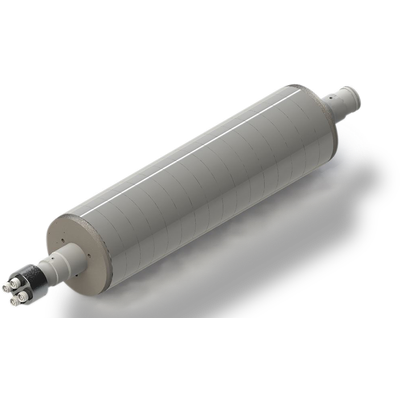
Vollmer - Segment Roll for Shape Measurement
Friedrich Vollmer Feinmessgerätebau GmbH has engineered segment rolls specifically targeted at shape measurement in stretch, bending, and levelling lines. The design incorporates outer rings on individual segment bodies that operate with remarkable smoothness, eliminating the need for auxiliary drives even when engaging with low strip tension and varying wrap angles. These segment rolls allow for continuous and highly precise shape measurement, with segment bodies available in widths of 33, 50, or 100 mm. Constructed with a coated outer ring, each segment is affixed to an inner base ring using ball bearings, which are directed by a ball bearing system along a rigid central axis. Each segment's axis is equipped with a force sensor leveraging strain gauge technology to monitor radial force in the strip within each measurement zone. The collected data is transferred to the flatness computer through connections like Profinet, TCP/IP, or analog and digital I/Os. These technical features ensure accurate communication with the system technology.
Extremely smooth running
We have developed segment rolls for shape measurement in stretch, bending and levelling lines Thanks to the extremely smooth running of the outer rings of the individual segment bodies, they do not require an auxiliary drive even with low strip tension and wrap angles.
The principle
Shape measurement is continuous and highly precise. The segment bodies, each corresponding to a measuring zone, can be selected in widths of 33, 50 or 100 mm.
Each segment body consists of a coated outer ring which is mounted on the inner base ring via ball bearings. This is guided by a ball bearing system on the rigid central axis. A force sensor using strain gauge technology is built into the axis of each segment body on which the bearing is supported. The sensors measure the resulting radial force of the strip there for each measuring zone.
The data is transmitted to the flatness computer through the rigid central axis of the roller. Communication with the system technology is via Profinet, TCP/IP or analogue and digital I/Os.