

- Home
- Companies
- Olpidürr S.p.A
- Products
- Ecopure - Selective Catalytic Reduction ...
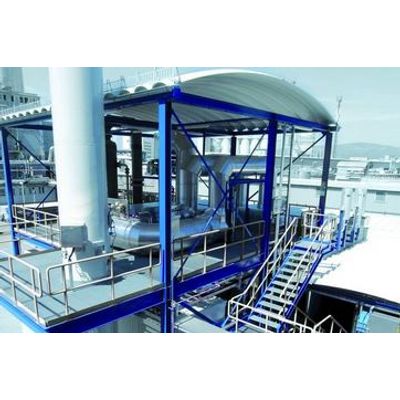
Ecopure - Selective Catalytic Reduction System (SCR)
Ecopure SCR Air Pollution Control Systems used for the selective catalytic reduction of nitrogen oxides (NOx) in flue gases and process exhaust gases when high nitrogen oxide conversion rates needed. They can be installed in Ecopure® VARsystems for flue gas purification or used as stand-alone units. As their name indicates, Ecopure SCR selective catalytic reduction systems based on the catalytic process.
- Can be combined with the Ecopure® VAR and the Ecopure® RTO
- Also available as a stand-alone system
- High purification level of 99% possible
- Low pressure loss
- Low operating temperatures
The Ecopure® SCR usually operates within a temperature range of 300 to 350°C. If the exhaust air entering the system is not at the required temperature, it must be pre-heated using an air-to-air heat exchanger, for example. The air is then heated further by a burner or another type of heater until it reaches the catalyst operating temperature.
The process of reducing the nitrogen monoxide (NO) and nitrogen dioxide (NO2) takes place in the catalyst. The function of the catalyst is to lower the reaction temperature, which would otherwise be between 900 and 1000°C, to the required operating temperature of 300 to 350°C.
After the reaction temperature and the catalyst startup temperature have been reached, an ammonia and water solution is injected into the system. The ammonia is used as reducing agent and reacts with the nitrogen monoxide (NO) and nitrogen dioxide (NO2) in the exhaust air to form nitrogen and water. The chemical reaction in the catalyst is selective. This means that the priority is to reduce nitrogen oxide levels while as far as possible suppressing the unwanted reactions of other substances.
After the nitrogen oxides have been converted in the catalyst, the energy is extracted from the clean gas by an air-to-air heat exchanger and used to pre-heat the untreated exhaust gas.
Ecopure® SCR Air Pollution Control Systems from Dürr are widely used in the chemical and petrochemical industries. This type of system has also proved to be an excellent solution for purifying exhaust gases from the glass manufacturing process.
Selective catalytic reduction is also used for:
- Combustion of pollutants that produce nitrogen oxide (NOx)
- Purifying the flue gases from directly heated steam generators
- Removing nitrogen oxide (NOx) from process exhaust gases
- Treatment of flue gas in power stations
The primary function of Ecopure® SCR systems is to purify waste air that contains NO and NO2.
The Ecopure SCR Air Pollution Control System consists of a catalytic reactor with an upstream support burner or electric heating system, an ammonia injection station, and a heat exchanger for recovering heat and pre-heating the exhaust air. A supply of heat is only needed if the exhaust air is below the reaction temperature of the pollutants or the startup temperature of the catalyst.