


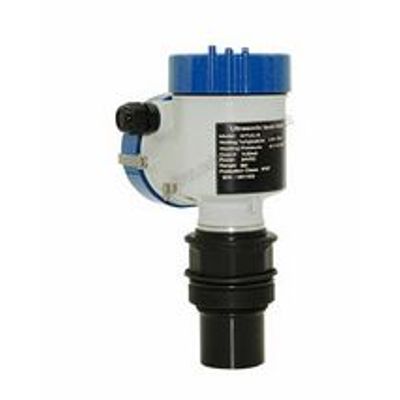
Sentec - Model SUL809 -Explosion Proof Ultrasonic Level Gauge -Anti Corrosion Ultrasonic Level Gauge
SUL809 Ultrasonic liquid level meter can adopt two-wire system, three wire system or four wire system technology. The two-wire system is: the power supply and signal output circuit are shared; the three-wire system is: the power supply circuit and signal output circuit are independent. When the DC 24 V power supply is used, a 3-core cable can be used, and the negative end of power supply and signal output share a core wire; the four wire system is: when AC 220 V power supply is used, or when the AC 220 V power supply is used, or when the signal output circuit is used, the ultrasonic liquid level meter can be used When the power supply circuit is required to be completely isolated from the signal output circuit, a 4-core cable should be used. DC or AC power supply, with 4 ~ 20mADC, high and low switch output.
The working principle of ultrasonic level meter is that the ultrasonic transducer (probe) sends out high-frequency pulse sound wave. When it meets the measured material level (material) surface, the reflected echo is reflected and converted into electrical signal. The propagation time of sound wave is directly proportional to the distance from the sound wave to the object surface. The relationship between the sound transmission distance s and the sound velocity C and the sound transmission time t can be expressed by the formula
S=C×T/2.
Because the transmitted ultrasonic pulse has a certain width, the reflected wave overlaps with the transmitted wave in a small area close to the transducer, so the distance value can not be measured. This area is called the measurement blind area. The size of blind area is related to the type of ultrasonic level meter.
The distance between the probe and the liquid (object) surface is proportional to the ultrasonic time
Distance [M] = time × sound velocity / 2 [M]
The temperature compensation formula of sound speed: ambient sound speed = 331.5 + 0.6 × temperature
The sensor takes the induced electromotive force E as the flow signal and transmits it to the converter. After being amplified, transformed and filtered, a series of digital processing is used, and the instantaneous flow and cumulative flow are displayed by dot matrix LCD with backlight. The converter has 4-20mA output, alarm output and frequency output. It also has RS-485 communication interface and supports Hart and Modbus protocol.