


- Home
- Companies
- Waters Corporation
- Products
- Sep-Pak SPE - Sample Extraction ...
Sep-Pak SPE - Sample Extraction Instruments
Sep-Pak products are recognized worldwide and remain the most referenced SPE products for GC/MS, HPLC, and LC/MS analysis, offering a wide variety of chemistries and configurations to complement the 96-well and patented* uElution plate format. Each design configuration offers specific functional benefits, but all contain the same high quality packing sorbents for reversed-phase, normal-phase, ion-exchange and specialty applications. This makes method transfer from one design to another straightforward and predictable.
Sep-Pak® 96-Well Plates are available with sorbents that have been proven for years in Sep-Pak cartridges. Introduced for high volume applications, the 96-well plate design has been optimized for robotic and automated sample handling systems as well as for standard vacuum manifolds. Sep-Pak plates are available with different sorbent mass selections to optimize sample loading.
Sep-Pak 96-well plates are extensively tested for quality. A certificate of analysis describes the performance of the pre-bonded and bonded silica phases in terms of ligand density, cleanliness and chromatographic selectivity. The plates are manufactured and tested to ensure consistent flow properties across the 96 wells.
Revered or Normal Phase
Amino Propyl (NH2)
- Silica-based polar bonded phase with basic character
- Can be used as a polar sorbent, like silica, with different selectivity for acidic/basic analytes or as weak anion exchanger in aqueous medium
- Applications include phenols and phenolic pigments, petroleum fractionation, saccharides and drugs and metabolites
Cyano Propyl (CN)
- Silica-based polar bonded phase
- Can be used as less polar alternative to silica in normal-phase applications or as less hydrophobic alternative to C18 or C8 in reversed-phase
- Applications; typical applications include drugs, drug metabolites and pesticides
Diol –
- Silica-based polar bonded phase with neutral character
- Can be used as an alternative to silica in normal phase applications, where the acidic character of silica is undesirable or as very weakly interacting phase in aqueous applications
- Applications include antibiotics from cosmetics; isolation of proteins or peptides by hydrophobic interaction chromatography
Normal Phase
Silica
- Polar sorbent, used primarily to adsorb analytes from non polar solvents like hydrocarbons, chloro- or fluoro-substituted hydrocarbons or less polar esters and ethers
- Elution with more polar solvents like polar esters, ethers, alcohols, acetonitrile or water
- The binding mechanism can be hydrogen bonding or dipole-dipole interaction
- Silica can also be used in aqueous medium as a cation exchanger of intermediate strength.
Alumina (A, B & N)
- Similar in use to silica; available in acidic, basic and neutral high activity grades
- Alumina also exhibits specific interactions with the pi-electrons of aromatic hydrocarbons, making it useful for applications like crude oil fractionation
- Acidic and basic grades can also be used as low-capacity ion-exchangers
Florisil®
- Polar, highly active, weakly basic sorbent for adsorption of low to moderate polarity species from nonaqueous solutions
- Specifically designed for the adsorption of pesticides using official AOAC and EPA methods
- Other applications include polychlorinated biphenyls (PCB’s) in transformer oil
| Sorbent/ Surface | Description | Typical Applications | * Properties |
| Sep-Pak® DNPH Diphenylhydrazine coated on silica | Acidified dinitrophenylhydrazine reagent coated on silica used for collection of air samples. Aldehydes and ketones react in situ to form hydrazone derivatives; these are then eluted and quantitated by HPLC analysis. | EPA Method TO–11A; ASTM D5197 for carbonyl compounds in air JPMOE official methods for aldehydes: odor in outdoor air [short body]; in exhaust gas [long body] | Particle size: 55–105 μm Pore size: 125 Å Recommended maximum capacity: 75 μg [2.5 μmoles] formaldehyde/cartridge |
| XPoSure Aldehyde Sampler Diphenylhydrazine coated on silica | Acidified dinitrophenylhydrazine reagent coated on silica used for collection of air samples. Aldehydes and ketones react in situ to form hydrazone derivatives; these are then eluted and quantitated by HPLC analysis. Larger particle size optimized for low-pressure personal air monitors. | • JPMHLW official methods for aldehydes in indoor air • EPA Methods TO–11A and IP–6A, ASTM D5197 for carbonyl compounds in air • NIOSH Method 2532 for glutaraldehyde in air | Particle size: 500–1000 μm Pore size: 125 Å Recommended maximum capacity: 70 μg [2.3 μmoles] formaldehyde/cartridge |
| Ozone Scrubber Potassium iodide | Potassium iodide cartridge is used in series with Sep-Pak® DNPH and XPoSure™ Aldehyde Sampler cartridges to remove ozone nterference. Ozone is consumed as it oxidizes iodide to iodine. | • EPA Method IP–6A and ASTM D5197 for carbonyl compounds in air | Quantity: 1.4 g KI Capacity: 4.2 mmoles ozone/cartridge [theoretical] |
| Sep-Pak® Dry Anhydrous Sodium Sulfate | High-capacity dessicant used to remove residual water from normal-phase SPE extracts [in water-immiscible organic solvents]. | • General purpose | Quantity: 2.85 g anhydrous Na2SO4 Theoretical capacity: 3.6 g H2O |
| Porapak® RDX DVB–N-Vinylpyrrolidone copolymer | Hydrophobic polymer designed to meet or exceed the QA/QC requirements of EPA Method 8330 and reduce solvent consumption 10-fold. It is used by environmental testing labs supporting U.S. Department of Defense remediation programs. | • Explosives in ground and surface water at ppb level | Particle size: 125–150 μm Pore size: 200 Å Typical sample volume: 500 mL water/cartridge |
| Sep-Pak® PS2 Styrene–DVB copolymer | Very hydrophobic copolymer designed for multi-residue pesticide analysis in water samples. | • JPMHLW official methods for pesticides in water • JPMHLW official methods for pesticides in food | Particle size: 80 μm Quantity: 265 mg/cartridge |
| Sep-Pak® AC2 Activated carbon | Highly hydrophobic, low ash content, activated carbon used to remove or enrich very polar organic molecules from water. | • JPMHLW official method for 1,4-dioxane analysis in water • Pesticides, herbicides, esp. highly polar small molecules | Particle size: 85 μm Quantity: 400 mg/cartridge |
| Carbon Black/ Aminopropyl Carbon black Aminopropyl silica | Two-layer sorbent bed used for pesticide cleanup in food matrices prior to GC analysis. | • JPMHLW official methods for pesticides in food • JPMHLW official method for propham | Particle size: 37–105 μm [carbon black, top layer] 55–105 μm [aminopropyl silica] Quantity: 500 mg of each sorbent, separated by frit |
C18
- Silica-based bonded phase with strong hydrophobicity
- Used to adsorb analytes of even weak hydrophobicity from aqueous solutions
- Typical applications include drugs and their metabolites in serum, plasma or urine, desalting of peptides, trace organics in environmental water samples, organic acids in beverages
- Similar in behavior to reversed-phase HPLC columns
tC18
- Silica-based bonded phase with strong hydrophobicity; trifunctional bonding chemistry gives it an increased hydrolytic stability over C18
- Applications similar to C18
C8
- Silica-based bonded phase with moderate hydrophobicity
- Used for methods requiring less retention than C18;
- Typical applications include drugs and their metabolites in serum,plasma or urine, peptides in serum, plasma
tC2 –
- Silica-based bonded phase with low hydrophobic character
- Used for methods requiring less retention than C8
- Applications are similar to C18 and C8
Porapak™ RDX
- Specially cleaned polymeric poly(divinylbenzene-vinylpyrrolidone) resin with hydrophobic character
- Can be used as an alternative to octadecyl-bonded silica for preparation of analytes that weakly adsorb to silica-based reversed-phase sorbents
- Compatible with sample or eluents at high and low pH
- Specifically designed for the concentration of high explosives in aqueous samples
Accell™ Plus QMA –
- Silica-based hydrophilic strong anion-exchanger with large pore-size; extraction of anionic analytes in aqueous and non-aqueous solutions
- Due to the large pore-size, it is excellent for the isolation of anionic proteins, e.g., immunoglobulins, enzymes
- Other applications include the removal of acidic pigments from wines, fruit juices and food extracts, isolation of phenolic compounds, peptide pool fractionations
Accell™ Plus CM –
- Silica-based hydrophilic weak cation-exchanger with large pore-size
- Extraction of cationic analytes in aqueous and non-aqueous solutions
- Due to the large pore-size, it is excellent for the isolation of cationic proteins
- Other applications include pesticides, herbicides, steroids
PSA (primary-secondary amine) SPE sorbent is a uniquely versatile sorbent exhibiting selectivity for normal-phase, weak anion-exchange, HILIC applications. When comparing to PSA to aminopropyl sorbents, the selectivity of PSA is similar; however, the two amine groups in the primary and secondary positions give PSA increased ion-exchange capacity and improved retention. When used as a normal-phase sorbent the higher carbon content of the PSA compared to aminopropyl offers increased non-polar interactions.
Available in all Sep-Pak® formats including carbon black/PSA tandems cartridges.
Primary-Secondary Amine (PSA)
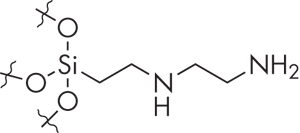
- A weak anion exchanger with pKa 10.1 and 10.9
- Stronger anion exchanger than aminopropyl
- Strong affinity and high capacity for fatty acids, organic acids, sugars
- Bidentate ligand allows for chelation
- Mean ion-exchange capacity 1.75 meq/g