


- Home
- Companies
- EssDe GmbH
- Products
- EssDe - Sewage Treatment Plants
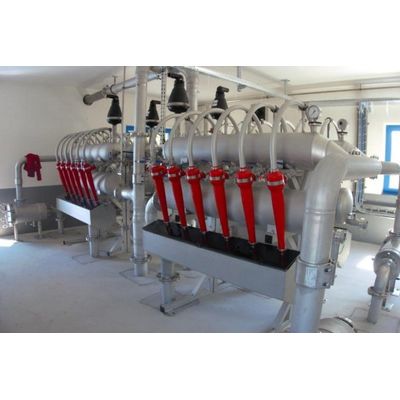
EssDe - Sewage Treatment Plants
Most of the aeration energy in a sewage treatment plant is required for nitrogen oxidation (nitrification). The subsequent denitrification requires carbon, which would be more advantageously converted into methane in the digester.
It is therefore obvious that the EssDe process, which can be classified as state of the art in the side stream, should now also be used in the main stream. The EssDe process works autotrophically, so it does not need any carbon and for nitrogen oxidation it only requires 40% of the amount of oxygen required in conventional nitrification.
This is counteracted by the fact that the deammonifying bacteria (planctomycetes) are extremely slow-growing. At the same time, the growth rate depends crucially on the water temperature, which is much lower in the main stream than in the side stream. The combination of the side stream with the main stream is therefore essential in order to produce the slow-growing bacteria in the side stream under favorable conditions and to pass the excess into the main stream.
However, the planctomycetes will be removed very quickly with the excess sludge in the main stream unless it is possible to selectively keep these bacteria in the system. This is achieved by separating the planctomycetes from the excess sludge in the main stream and recycling them. This process is another patent from EssDe GmbH.
In addition, deammonification always starts from nitrite. In the main stream, the competition from NOBs, i.e. nitrite-oxidizing bacteria, is very strong. The AOBs must be strengthened through additional measures in such a way that a nitrite surplus is guaranteed, which can then be used by the plantomycetes.
The further energetic optimization of an activated sludge system is then achieved by connecting an A stage (adsorption stage).
The majority of the carbon is fixed by adsorption in a very highly polluted A stage, possibly combined with preprecipitation, and added directly to the digestion. Not only is additional (aeration) energy saved by avoiding the build-up of activated sludge and endogenous respiration, but at the same time a lot more digester gas and therefore energy is obtained.
The concept described has been known as the AB process for many years and has often been implemented on a large scale. The crucial disadvantage of the process was that there was no longer enough carbon available for denitrification in the lightly loaded B stage. With the EssDe process, the tool is now available with which the maximum amount of energy can be saved or gained while at the same time achieving the greatest possible nitrogen elimination.
The arguments:
- Maximum energy surplus thanks to minimized oxygen consumption and maximized digester gas production
- Efficient nitrogen elimination thanks to EssDe® in the side and main flow
- Less sludge accumulation
- Significantly better sludge dewatering
- Conversion possible using the existing substance