


- Home
- Companies
- Waters Corporation
- Products
- SFC Columns
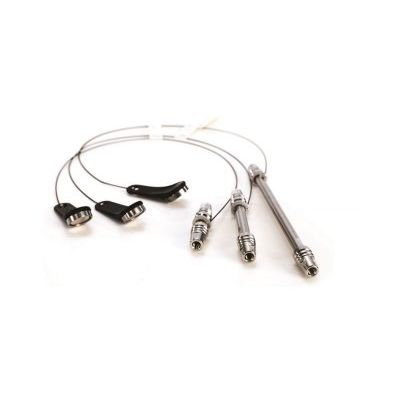
SFC Columns
Waters offers three unique brands for SFC chromatography. Our newest addition includes Torus Columns in preparative formats due its excellent performance for a wide range of compounds and matrices. Our Torus and Viridis lines for achiral SFC applications are available in analytical and preparative particle sizes ranging from 1.7 µm to 5 µm. The preparative format utilizes our patented OBD Technology to ensure ease of scale-up as well as column-to-column consistency. Trefoil Columns, for chiral SFC chromatography, are uniquely designed for the ACQUITY UPC2 System for selectivity and speed in separations as well as reduced method development time.
Torus Columns for Achiral Separations
The Torus phases are based on a new patent-pending two-stage functionalization of ethylene bridged hybrid (BEH) particles. The initial bonding provides a hydrophilic surface that controls the retention characteristics of the sorbent, and is responsible for minimizing unwanted surface interactions, which lead to retention and selectivity changes over time. The second step of the functionalization is responsible for the individual selectivity and peak shape characteristics of each of the Torus chemistries. The results of these steps are a series of stationary phases with broad ranging selectivities, which maintain robust chromatographic performance over the lifetime of the column. Torus Preparative Columns were developed utilizing OBD packing technology.
Scale SFC from Analytical to Prep with Torus
Access the power of normal-phase chromatography with the ease and reliability of reversed-phase chromatography.
Torus Columns are available in four scalable Chemistries:
- Torus 2-PIC 1.7 μm → Torus 2-PIC 5 μm
- Torus DEA 1.7 μm → Torus DEA 5 μm
- Torus DIOL 1.7 μm → Torus DIOL 5 μm
- Torus 1-AA 1.7 μm → Torus 1-AA 5 μm
Torus 2-PIC (2-Picolylamine)
Torus 2-PIC Columns were designed for general use and are the first choice for a wide range of applications with acidic and basic compounds. The Torus 2-PIC phase demonstrates enhanced performance compared to conventional 2-ethylpyridine (2-EP), displaying improved peak shape, added retention, and novel selectivity. In addition, these columns provide extra flexibility to method development as they maintain exceptional peak shape for a wide range of compounds.
Torus DEA (Diethylamine)
Torus DEA Columns are designed to be orthogonal to the Torus 2-PIC phase. These columns provide a complementary selectivity to the 2-PIC phase and are designed to provide superior peak shape for very strong bases.
Torus DIOL (High Density Diol)
Torus DIOL Columns were developed to provide additional selectivity choices within the Torus family. The high density Diol surface bonding offers chromatography similar to that from the traditional unbonded silica phases, but adds overall method robustness when utilized with acidic or basic additives.
Torus 1-AA (1-Aminoanthracene)
Torus 1-AA Columns are designed to be the superior choice for separating neutral compounds such as polar and non-polar steroids, and hydrophobic compounds such as lipids and fat-soluble vitamins. This chemistry also provides an orthogonal selectivity (S > 90) to the 2-PIC phase, making it very useful in method development.
- Hydrophobics (lipophilic) compounds
- Free fatty acids
- Fat-soluble vitamins
- Lipids
- Natural products
- Steroids
Transfer Normal Phase Methods to SFC Chiral Methods
Legacy normal-phase chiral methods can be easily transferred to the ACQUITY UPC2 System using Trefoil Columns. Many of these old methods have undesirable characteristics such as long run times and often use chlorinated solvents in combination with THF or hexane which are costly to purchase and dispose of. With simple redevelopment, new cost effective methods can be obtained using inexpensive and non-toxic compressed liquid CO2 as the primary mobile phase and can be coupled to mass spectrometers for greater information.
Trefoil Columns for Chiral Separations
Trefoil modified polysaccharide-based stationary phases provide broad-spectrum chiral selectivity. Trefoil AMY1, Trefoil CEL1, and Trefoil CEL2 column chemistries are complementary to each other and independently offer different retention characteristics for separating chiral compounds. Selectivity can be further enhanced by blends of modifiers and additives that most favorably modulate chiral recognition. These columns are designed to separate enantiomers, stereoisomers, metabolites, degradants, and impurities with greater resolution and speed.
Chiral Methods using Trefoil Columns
Faster method development is possible when taking advantage of the dependable, high performance, low dispersion analytical ACQUITY UPC2 instrument when used together with the Trefoil chiral stationary phases. Using short, narrow bore columns with a small number of well selected co-solvents and mass spectrometry compatible additives enables this holistic combination to achieve routine gradient screening runs in 2 minutes.
Viridis SFC Columns
Viridis SFC Columns are available in six chemistries for analytical and preparative chromatography. Viridis Preparative Columns were developed utilizing OBD packing technology.
- BEH 2-EP (2-Ethylpyridine) - Good retention, peak shape and selectivity.
- BEH - Heightened interaction with polar groups such as phospholipids.
- CSH Fluoro-Phenyl - Good retention of weak bases and alternate elution orders for acidic and neutral compounds.
- HSS C18 SB - Analysis of glycerides (used in pharmaceutical, food, and chemical applications).
- Silica 2-EP - Widely used in achiral SFC separations and good retention, peak shape and selectivity.
- Silica - Heightened interaction with polar compound functional groups, when compared to the less polar surface of Silica 2-EP.
ACQUITY UPC2 QC Reference Materials
The ACQUITY UPC2 Quality Control Reference Material provides an easy and reliable way to monitor the performance of your ACQUITY UPC2 System. Designed for use with both Trefoil and Torus Columns, this four component mixture was optimized for the following key chromatographic performance factors:
- Compounds are well separated and cover a wide chromatographic elution range
- Contains a chiral compound to test chiral separation power
- Contains an ionizable compound, to test mass spec performance