


- Home
- Companies
- Baoji City ShenAo Metal Materials Co., ...
- Products
- ShenAo - Coated Titanium Electrode
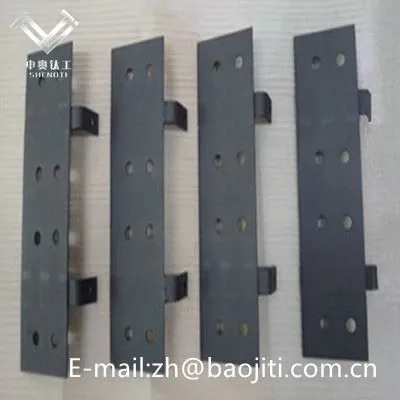
ShenAo - Coated Titanium Electrode
Coated titanium electrode is a new type of electrode that uses metal as a base and is coated with an active coating with platinum group metal oxide as the main component on the surface. It is generally called DSA (Dimensionaly Stable Anode) at home and abroad.
Titanium anodes for the chemical industry
Titanium anodes are directly and often in contact with extremely chemically active moisture, new ecological oxygen, hydrochloric acid, and secondary gas acids. Therefore, the anode material should have strong chemical corrosion resistance, low chlorine overpotential, and good electrical conductivity. It has high mechanical strength, is easy to process, is cheap, and is easily available.
Chlor-alkali industry
Electrolysis of salt water solution to produce chlorine and caustic soda has a history of more than 100 years. During the development of chlor-alkali production, platinum, magnetic iron oxide, carbon, artificial graphite, etc. were tried as electrodes. After years of exploration, people finally found an ideal coating. ,ri electrode materials. RuTi0, a coated electrode invented by Beer, was first used as an anode for the production of chlorine by the mercury method. The electrode is resistant to sodium and mercury corrosion and has been successful.
RUT-coated electrodes are used in the production of ammonia and alkali. They have the advantages of minimal exposure, greatly reduced ammonia evolution potential, sufficient shape, easy detachment of the generated ammonia bubbles, and insufficient retention in the electrolyte. Therefore, the news Quickly replaces graphite electrodes. In the 1980s, there were more than 1x10⁵m2 of titanium electrodes used in the chlor-alkali industry in Japan and more than 1x10⁶m2 in the world. Taking the commonly used type 30 battery in China as an example, there are more than 30,000 type 30 titanium electrode batteries installed around the world. A 30-type battery cell uses 210kg of titanium material, and the titanium electrode battery cell uses 7X10⁶kq titanium material. It can be seen that the chlor-alkali industry is the sector that uses the largest amount of titanium electrodes.
RUT-coated electrodes are used in chlor-alkali production. They have the advantages of minimal loss, greatly reduced gas evolution potential, stable size and shape, easy detachment of generated gas bubbles, and no retention in the electrolyte. Therefore, they have quickly replaced graphite electrodes. In the 1980s, there were more than 1x10⁵m2 of titanium electrodes used in the chlor-alkali industry in Japan and more than 1x10⁶m2 in the world. Taking the commonly used type 30 battery in China as an example, there are more than 30,000 types 30 titanium electrode batteries installed around the world. A 30-type battery cell uses 210kg of titanium material, and the titanium electrode battery cell uses 7X10⁶kq titanium material. It can be seen that the chlor-alkali industry is the sector that uses the largest amount of titanium electrodes.
During the electrolysis of salt water, the main reaction on the anode is the chlorine evolution reaction, and the side reaction is the oxygen evolution reaction. The requirement for the coated electrode is that the gas overpotential is small and the oxygen overpotential is high. However, the RuTiOx coating also has a low oxygen evolution potential after long-term use, that is, it has a high electrocatalytic activity for both chlorine evolution reaction and oxygen evolution reaction. The selectivity of the reaction is not good, causing the oxygen content in the anode product gas to increase, which is undesirable. Research has found that adding rO2 and SnO2 to the coating can.
It retains the advantages of high chlorine evolution current efficiency of RuTiOx coating and can also reduce the oxygen content in chlorine. Therefore, most of the chlor-alkali production currently uses RulrTiOx or RuSnTiOx ternary component mixed coating. Since the titanium anode coating uses a large amount of platinum group metals, This results in increased titanium anode manufacturing costs. Nanotechnology is considered one of the three major technologies in the 21st century. Consideration can be given to improving the high specific surface area of metal oxides in coatings at the micro level to produce high activity. It can also maintain titanium with little or no use of precious metals. Excellent anode performance. In the mid-1990s, domestic and foreign companies began to combine nanotechnology with electrocatalysis science. Nanoscale RU02 was prepared by vapor deposition, and nanoscale ruthenium-titanium mixed oxide was prepared by the IrO2:methane sol-gel method.
Chlorate production
Chlorate uses a diaphragm-less electrolytic cell, and the raw material is a saturated sodium chloride solution. Chlorate is produced by electrolysis of salt water. In the past, anode materials such as graphite, magnetic iron oxide, and lead dioxide were used. Now, RuO, a coated titanium anode, alkali acid salt graphite anode milk cell is used, and the current efficiency is 82%~87%. , after using a metal anode, the current density increases by 3 to 4 times, and the current efficiency increases to about 95%: it can also be operated at high temperatures, and the DC power consumption is easily reduced. Increasing the temperature can increase the speed of the chemical reaction to form C103 and improve the current efficiency. However, increasing the temperature will intensify the corrosion of electrode materials and equipment by the electrolyte. Therefore, the choice of electrolysis temperature is subject to the corrosion resistance of the material. When using graphite anodes, electrolysis can generally only be performed at 35°C~40°C, but when using DSA, electrolysis can be performed at 80°C.
Increasing the current density can improve production efficiency and reduce equipment investment, but it will increase the cell voltage and increase energy consumption. The current density depends on the electrocatalytic activity and stability of the electrode material. Using graphite anodes, the current density can generally only be below 600A/m. After using DSA, the current density can reach 2000A/m~3000A/m2.
Hypochlorite production
Sodium hypochlorite is produced in large quantities using chemical methods. In recent years, a small electrolysis device that can produce a small amount of sodium subgasate solution for users anytime and anywhere has been developed due to its simple structure, low cost, and easy use and maintenance.
It has been widely used, mainly in hospital sewage treatment, electroplating factory wastewater treatment, mine cyanide-containing wastewater treatment, environmental protection, health and epidemic prevention, etc.
Sodium hypochlorite is produced by electrolysis using diaphragm-less electrolysis. The raw material is salt water. During electrolysis, the chlorine gas precipitated by the anode reaction dissolves in the electrolyte to generate HC1 and HCIO. The OH ions generated after H2 are precipitated at the cathode combined with the generated H.
H20 and NaC10 are generated.
As anode materials in sodium hypochlorite generating devices, Pt, IrRu alloys, and Ti-plated Pt electrodes are often used abroad, but they are expensive and difficult to promote and use. Graphite and lead dioxide were often used in China in the past, but now coated titanium electrodes are mainly used.