


- Home
- Companies
- Sigma Space Corporation, a part of ...
- Products
- Sigma - Advanced Photon Counting System ...
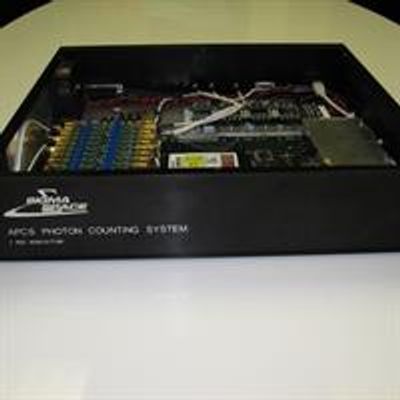
Sigma - Advanced Photon Counting System (APCS)
The Advanced Photon Counting System (APCS) card was designed to enhance and expand NASA’s Cloud Physics LiDAR (CPL) system. Since 2003, the APCS has been used in CPL, flying in both ER-2 and Global Hawk platforms. To date, it has flown in over 20 different field campaigns. The APCS card is also used as the primary data collection source for the Tropospheric Wind LiDAR Technology Experiment (TWiLiTE) instrument which has also flown in both the ER-2 and Global Hawk.
The APCS card provides powerful system-level functions common to many pulse counting, integrating, and histogramming data collection applications. In addition to being 10-detector input multichannel scaler, the APCS card provides for four serial UARTs (two of which can be configured as a RS-232 or RS-422 and two which are for future command functionality), 16 A/D inputs for housekeeping data collection, power outputs (+12V, -12V, and +3.3V) for peripheral usage, a battery-backed real-time clock chip (for time tagging data), 10 outputs configured as pulses or discretes, and signals for cascading more than one APCS card in a system. The APCS card uses a USB 2.0 interface and may be operated in local or remote (embedded) modes. Most of the APCS card`s parameters are software configurable by the user while certain parameters may be hardwired on the APCS circuit board prior to customer delivery. The APCS card also has a connector and mounting holes for the direct connection of an optional 2.5 hard drive for direct storage of all collected data as well as a connector for a daughtercard that provides five detector channels of 1 ns (1 GHz) resolution. The APCS card may be updated via the USB 2.0 port, providing for future expandability and for convenience in debugging. The APCS card has a form factor 6.5" x 10”. A software driver development package and test application are also available.
- Low power
- USB 2.0 Interface
- A/D inputs, Communications ports, Storage