


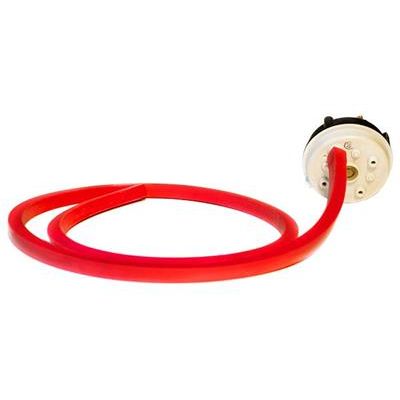
Silicone Rubber Products: Rubber Tubing and More
If you need a rubber product that can withstand difficult environments, silicone rubber can be an excellent choice for your applications. When it comes to extreme temperature, silicone rubber offers great resistance, being able to operate normally from -100°C to +250°C (-150°F to +480°F). At extreme temperatures, the tensile strength, elongation, tear strength and compression set can be far superior to conventional rubbers. This makes it one of the materials of choice in many extreme environments.
Silicone is a very clean rubber with low odor and taste. In addition to temperature resistance, other advantages of silicone rubber include insulation from electricity, compression set resistance, and the ability to repel water. Because of these advantages, silicone rubber is a versatile material for many industries, including:
Custom silicone rubber parts can be used in the production of:
Caution: Generally, silicones are attacked by most concentrated solvents, oils, acids, and dilute sodium hydroxide.
- Common Name: Silicone
- ASTM D-2000 Classification: FC, FE, GE
- Chemical Definition: Polysiloxane
- Temperature Range
- Low Temperature Usage: -60° to -150° F | -50°C to -100°C
- High Temperature Usage: Up to 480° F | Up to 250°C
- Tensile Strength
- Tensile Range: 200-1500 P.S.I.
- Elongation: 700% Maximum
- Resistance
- Abrasion Resistance: Fair to Poor
- Tear Resistance: Poor
- Solvent Resistance: Poor
- Oil Resistance: Fair to Poor
- Caution: Generally, silicones are attacked by most concentrated solvents, oils, acids and dilute sodium hydroxide.
- Additional Properties
- Aging Weather - Sunlight: Excellent
- Adhesion to Metals: Good
- Durometer (Hardness) Range: 30-90 Shore A
- Compression Set: Good
- Resilience/Rebound: Good
- Industrial Classifications
- Liquid Silicone Rubbers (LSR) - also called heat curable liquid materials. Processed on specially designed injection molding and extrusion equipment.
- High Temperature Vulcanizing (HTV) - also called heat curable silicone, these materials usually are in a semi-solid gum form while in the uncured state. Rubber-type processing is required to produce finished items.
- Room Temperature Vulcanizing (RTV) - usually comes in the form of a flowable liquid. Commonly used for sealants, mold making, encapsulation and potting. RTV materials are generally not used as conventional rubbers.
- Silicone Compounds
- Silicone rubber material can be compounded in different ways to meet any number of applications.
- Silicone fillers can also improve the tensile strength to be in the area of 1500 PSA and tear resistance up to 200lbs.
- Flame retardant additives can be added to increase fire resistant properties.
- Carbon black additive will also increase the silicone`s electrical conductivity.
Mechanical Engineering
- Square, kink free tubing for furnace pressure switches
- Sound and vibration dampening in automotive drive shaft applications
- Shaft sealing rings
- Silicone O rings
- Window and door seals
- Sealing Gaskets
- Oven door gaskets
Electrical Engineering
- Wire and cable jacketing
- Electrical Safety Stinger Covers
- Conductive profiled silicone seals
Additional Applications
- Many closed cell silicone sponge and silicone gaskets have flame retardant properties making them suitable for gasket applications in Mass Transit systems, telecommunications equipment and HVAC applications.
- UL94 V-0 silicones are used in consumer electronics and business equipment and in closed spaces such as aircraft, subways and building interiors.