


Sino Biological Inc.
- Home
- Companies
- Sino Biological Inc.
- Products
- Sino - Model 100002-MM02 - Mouse ...
Sino - Model 100002-MM02 -Mouse Monoclonal Anti-Histone H3 Antibody
This antibody was produced from a hybridoma resulting from the fusion of a mouse myeloma with B cells obtained from a mouse immunized with a synthetic peptide corresponding to the C-terminus of the Human Histone H3. The IgG fraction of the cell culture supernatant was purified by Protein A affinity chromatography.
Most popular related searches
cell culture supernatant
mouse monoclonal antibody
cell culture
DNA replication
chromatography product
PFAS
incubator
chromatography
protein structure
- Species reactivity Reacts with: Human
- Specificity Human Histone H3
- Immunogen A synthetic peptide corresponding to the C-terminus of the Human Histone H3
- Source Monoclonal Mouse IgG2b Clone #02
- Purification Protein A
- Formulation 0.2 μm filtered solution in PBS
- Conjugate Unconjugated
- Form Liquid
- Shipping This antibody is shipped as liquid solution at ambient temperature. Upon receipt, store it immediately at the temperature recommended below.
- Storage This antibody can be stored at 2?-8? for one month without detectable loss of activity. Antibody products are stable for twelve months from date of receipt when stored at -20? to -80?. Preservative-Free. Avoid repeated freeze-thaw cycles.
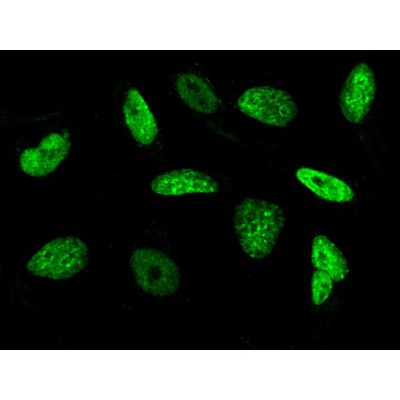
Immunofluorescence staining of histone H3 in Hela cells. Cells were fixed with 4% PFA, permeabilzed with 0.1% Triton X-100 in PBS,blocked with 10% serum, and incubated with mouse anti-human histone H3 monoclonal antibody (dilution ratio 1:60) at 4? overnight. Then cells were stained with the Alexa Fluor®488-conjugated Goat Anti-mouse IgG secondary antibody (green). Positive staining was localized to nucleus.
Histone H3 is a histone protein. Histones are basic nuclear proteins that are responsible for the nucleosome structure of the chromosomal fiber in eukaryotes. They play a central role in transcription regulation, DNA repair, DNA replication, and chromosomal stability. Two molecules of each of the four core histones (H2A, H2B, H3, and H4) form an octamer, around which approximately 146 bp of DNA is wrapped in repeating units, called nucleosomes. Histone H3 is characterized by a main globular domain and a long N-terminal tail. It is involved with the structure of the nucleosomes of the `beads on a string` structure. There are five main histone proteins involved in the structure of chromatin in eukaryotic cells. Histone H3 is the most extensively modified of the five histones. In the emerging field of epigenetics, it is thought that Histone H3 plays a key role, cause its sequence variants and variable modification states function in the dynamic and long term regulation of genes.