
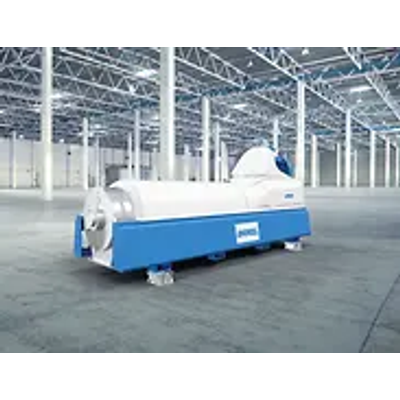
Andritz - Model D -Sludge Centrifuge
The ANDRITZ decanter centrifuge D is engineered with advanced wear-resistant materials, ensuring a long and continuous life cycle. Our diverse material options guarantee that your operations can withstand high temperatures, heavy-duty applications, and corrosive environments. Whether you need dewatering or thickening, our centrifuges can handle wide ranges of flow rates and types of sludge, delivering state-of-the-art separation tailored to your specific inputs, processes, and objectives.
For solid-liquid separation processes like thickening and dewatering, this machine provides a reliable, well-established solution, continuously refined to enhance performance, reduce energy consumption, and lower operational costs.
The ANDRITZ decanter centrifuge D offers versatile solid-liquid separation, adaptable to achieve desired dry solids content. It handles both sludge thickening and dewatering from diluted sludge, making it ideal, for example, for processes like pre-dewatering in Thermal Hydrolysis (THP) plants. Its dual functionality allows operation in thickening mode for field spreading and dewatering when spreading is restricted. It’s also effective for pig manure separation, producing clarified liquid with over 80% TSS capture and dewatered solids with the granularity needed for efficient composting.
As with all sludge dewatering and thickening technologies, performance of the ANDRITZ decanter centrifuge D is affected by the conditioning process, such as polymer type and dosage.
But unlike other sludge separation technologies, the ANDRITZ decanter centrifuge D can still achieve a high solid/liquid separation rate in many applications without slurry pre-conditioning.
Low power consumption sludge dewatering centrifugeLeading the way in green technologies, we drive innovation through energy efficiency
Get more results with less energy. ANDRITZ is committed to reduce your operation costs and to save valuable resources by continuously improving the efficiency of our decanters depending on your flow and your application, by providing some additional features:
Key energy-saving features
-
The High Hydraulic Pressure (HHP) design of the rotating assembly reduces the discharge radius of the clarified liquid (centrate). Besides improved separation characteristics, this design helps to recover the kinetic energy of the fluid to reduce energy consumption by up to 15%.
-
Working the same way as a jet engine, the TurboJetTM weir plates recover the remaining kinetic energy of the clarified liquid. By creating liquid jets pointing in the opposite direction to the bowl rotation, the reaction force thus supports bowl rotation. The TurboJetTM weir plate reduces total power consumption by up to 30% as a stand-alone feature.
-
As a standard feature, ANDRITZ offers two drive systems: a regenerative back drive and a direct drive. Whereas common back drive systems dissipate the braking energy of the scroll into heat, the regenerative back drive recovers this energy and feeds it back to the main motor. The direct drive system feeds the scrolling power directly to the scroll and therefore avoids recirculation losses, thus reducing total power consumption by another 5%.
-
The unmatched TurboWISETM solution is key to performance in the raw material feed chamber. The polyurethane liners of the TurboWISETM system can be replaced easily on site and serve to accelerate the incoming slurry efficiently. The computational fluid dynamic optimization ensures lowest flocculant consumption, significantly reduced wear, and decreases the total power consumption again by up to 2%.
The ANDRITZ decanter centrifuge D is designed with a focus on environmental impact and safety. It features low energy consumption, reduced noise, and a design aimed at minimizing vibrations. The machine also includes safety systems like automatic shutdowns in case of malfunction, and it adheres to strict regulatory standards for environmental safety and operational efficiency.
-
Easy and immediate change of process settings due to variable scroll and bowl speeds
-
Fast dismantling design
-
Optimum process performance due to adjustable pond depth and automatic control system
-
Lowest possible machine downtime due to easy, fast, and efficient service and maintenance
-
High capacity and dryness while using only minimum of additives
-
High level of wear protection
-
Minimum footprint requirements due to in-line design results in smaller building footprint so lower total installed costs