

Universal Drying Systems
- Home
- Companies
- Universal Drying Systems
- Products
- Sludge Pyrolysis
Sludge Pyrolysis
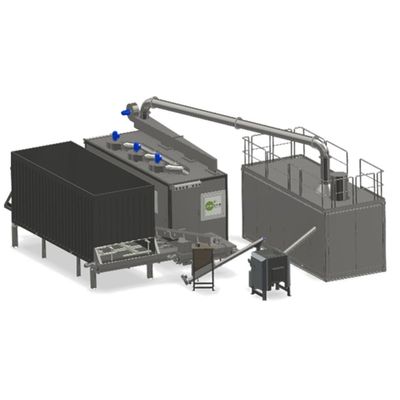
Pyrolysis is the heating of organic material, such as biomass, in the absence of oxygen. Because no oxygen is present the material does not combust but the compounds that make up that material thermally decompose into combustible gases and charcoal. The produced bio(based)char can be seen as carbon sequestering agent having a CO2 positive balance and helps to fulfill worldwide requested climate goals.
Most popular related searches
municipal sewage treatment plant
sewage sludge treatment system
municipal sewage treatment
food waste drying
sewage treatment plant
flue gas sampling
flue gas cleaning
municipal sewage treatment sludge
waste drying
sewage sludge
When our pyrolysis system is integrated with the Jumbo Dryer and Pelletizer several advantages are realized:
- The Pyrolysis gas fuels the dryer which can eliminate the need for additional fuel.
- Carbon/Biochar/Carbonisate pellets are produced and can be sold for high quality fertilizer.
- CO2 is captured in the carbon pellets. Keyword CO2 Balance!
- CO2 credits can be sold on the open market.
Pyrolysis is an attractive way to utilize the biogenic residues from a wide range of processes such as:
- Sewage sludge from municipal sewage treatment plants.
- Sewage sludge from the industrial production of foodstuffs.
- Dairy Waste
- Food Waste Dryer
- Fish Waste Dryer
- Completely continuous and independent operation; state-of-the-art degree of automation; in principle, can be operated unmanned!
- Modularity of the plant; easily expandable in terms of capacity.
- Possibility to discharge a thermal utilization product (= carbonate) with high carbon content! Keyword CO2 balance!
- Solid fraction is thermally converted into biochar.
- Due to the two-stage combination in one system, it is possible to thermally convert the dried input material in a “gentle” and low-dust way.
- By combining the thermal utilization in direct form with the dryer, flue gas cleaning takes place at the same time.
- The high temperatures produce a high-quality Carbonisate – which has a high degree of carbonization.