


- Home
- Companies
- IST-Anlagenbau GmbH
- Products
- WendeWolf - Solar Drying of Sewage ...
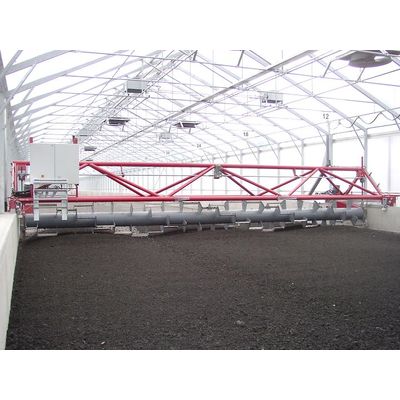
WendeWolf - Solar Drying of Sewage Sludge
Introduction: Any Sewage Water Work throughout the world will produce sludge, a form of biomass growing in the basins. This biomass has to be evacuated and is, generally speaking, difficult to handle! When liquid it has a dry matter of 3 to 4 %, or only 30 to 40 kg per ton of sludge. When mechanically dehydrated to 20 - 25 % dry matter, most of it is still water, on average 750 to 800 kg per ton of filter cake. This remaining water can only be extracted with thermal methods.
In southern areas open air drying beds or sludge lagoons are widely used but have, over the years, shown some well known serious problems such as:
- Bad odours
- Polluting the ground water table
- General hygiene for the people handling the sludge
- Breeding ground for insects and germs
- Difficulties in emptying or refurbishing when filled up
- Difficult to use it as a fertilizer in agriculture
A mechanical dewatering system is additionally required before using the WendeWolf®, but these problems mentioned above are solved.
The solar radiation warms the sludge`s surface. The rise in the temperature forces the water molecules out into the surrounding air. The moist air transports the water and has to be evacuated. However, while the surface dries, the lower parts remain moist, and have to be turned.
This is achieved by WendeWolf®, a turning and conveying machine mounted on walls, yielding a dry granulate of 10 mm as an average size. As the radial velocity is higher than the advancing speed, each time the drum turned the sludge is automatically moved from one end of the drying bed to the other.
The drying bed is fed and emptied with appropriate equipment such as conveyor belts or shovel loaders but the transport through the bed is entirely automatic!
The system consists of:
- A waterproof horizontal surface, either concrete or asphalt, similar to a road
- Two parallel walls 12.00 m apart, 0.85 m high and up to 120 m in length, equal to a drying bed of 1440 m²
- Electrical power supply 400 V, 12 kW
- Road access at both ends
- The WendeWolf® machine, mounted ready for use, is transported in a container to the site. Weighing 4000 kg, with a gauge 11.40 m, it is fully equipped with sensors and control units. The central part is a drum on which different combs and paddles are fixed which cut the sludge`s surface and aerate the lower parts
- Operating panel with a touch screen
- A greenhouse with ventilators (2-3 W/m² drying area) at sites with regular rainfall
The WendeWolf® moves and aerates up to 250 m³/h of sludge! The automatic programme ensures a continuous flow of the freshly pressed sludge through the drying bed.The required energy consists of electricity only, between 10 kWh to 30 kWh per ton of water evaporated. Industrial dryers require between 800 and 1000 kWh in thermal energy and electricity. Therefore the running cost of WendeWolf® is extremely low!However the system requires space to be built. As WendeWolf® is successfully used in the European climate, with an annual evaporation of 800 - 900 kg/m²year, we anticipate for example the double in the Middle East.
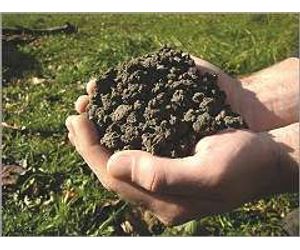
When drying the sludge with the WendeWolf® , the volume decreases linearly to the water loss, thus leaving only 1/5th of the original mass to be evacuated.The original sludge is transformed into a granular bio-solid which is easy to handle and which can be stored in heaps, containers or bags.The granulate is odourless and if an agricultural use is permitted it can be spread with conventional machinery.
In Europe the reason for drying the sludge is the high cost of the final treatment, so each ton of water extracted from the sludge lowers the annual cost for the water plants.Solar drying requires space and initial funding, but the running costs are extremely low.WendeWolf® yields an end product which has the same high quality as industrially dried material but at a lower running cost.
WendeWolf® installed in 6 countries in Europe and in Australia.
The main component of the dryer is the reversing and conveying machine called WendeWolf®.The machine runs on two parallel walls 12 m apart, 0.85 m high and up to 120 m in length.
The central part is a drum on which different combs and paddles are fixed which cut the sludge`s surface and aerate the lower parts.The drum can be lowered from a free height of 50 cm to the ground with a central motor and two toothed racks which are mechanically linked.The drum turns with a frequency of up to 60 c/min and conveys the sludge below while slowly moving.
The unit can move and rotate in both directions and is controlled by frequency driven motors. It is fully equipped with sensors and control units.
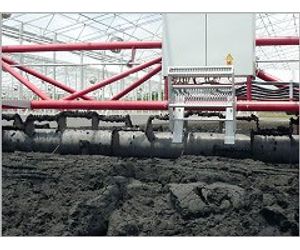
The WendeWolf® is mounted ready for use and transported in a container to the site. An operating panel with a touch screen is mounted beside the drying bed. The installation and commissioning requires only two days.
Physical Background
Any drying process is based on the fact that water molecules change from liquid into gas, called vapour. This requires energy. Our option is freely available solar energy.The driving force of drying is the difference between the partial vapour pressure inside the sludge and the ambient air. In order to avoid an equilibrium between the vapour pressure inside and outside the sludge, the air has to be evacuated. This is naturally helped by the fact that water vapour is lighter than dry air.The warmer the air is the more water vapour can be transported. However the partial vapour pressure in the air rises with the amount of water dissolved in the air. Except for very damp days, the drying process still occurs even in low sunshine. This is the same process that allows a wet road to dry at night.
Open Air Drying Beds - Natural Ventilation
They are naturally ventilated by the wind. The higher the wind speed blowing over the sludge surface, the faster the drying speed. However at sites with regular rainfall, an open air drying bed is not as satisfactory.For this reason in Middle Europe open air drying beds are no longer in use. Solar drying is done in greenhouses which require controlled ventilation systems
Greenhouse Drying - Controlled Ventilation
An efficient ventilation system has been developed and monitored in the different plants and sites where WendeWolf® turning machines are installed.Our ventilation system has three components:
Roof Ventilation Flaps
Motor driven roof ventilation flaps are installed over the entire length of the drying hall. These are similar to those used in many greenhouses for ventilation.
Axial Fans
Fans are placed inside the hall in such a way that air turbulence is created above the entire surface of the drying bed, destroying the moist boundary layer above the sludge surface. This artificial wind is important for the drying process as it avoids any stratification of temperature or humidity.
Aperture Slits
An aperture slit is positioned between the greenhouse and the walls on which the WendeWolf® is travelling. Whenever the roof flaps are opened, a natural draft occurs and fresh, dry air enters the greenhouse
Control Strategy - Solar Energy Only
The temperature and the relative humidity is monitored outside and inside each hall. The PLC (Process Logical Control) calculates the temperature difference and the absolute water content inside and outside for each hall separately. The respective thresholds can be altered.
- Axial fans are switched on when the temperature inside is five degrees higher than outside
- Roof flaps are opened when the calculated value of the absolute humidity inside exceeds a threshold of 1.5 g/kg Air
Control Strategy with Auxiliary Heating
When auxiliary heat is available, a heating system may be installed in the hall. Different systems are possible and have been used in different sites:
- Floor Heating
- Hot Air Blowers
- Infrared Radiators
The axial fans are controlled by the temperature difference inside/outside blowing the warm air downwards and breaking up the moist layer of air at the sludge surface. The hall must have doors and the roof flaps are able to be closed to limit thermal energy loss. The flaps are only opened when the absolute water content of the air inside has reached a certain ratio to the outside ambient air. As warm and moist air rises, the exchange is rapidly achieved and the flaps close again.