


- Home
- Companies
- Soletair Power
- Products
- Soletair Power - Building Carbon ...
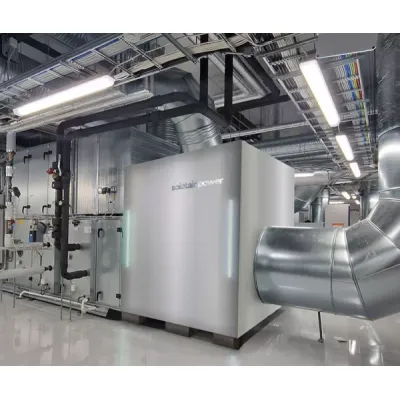
Soletair Power - Building Carbon Capture Technology
Soletair Power harnesses Direct Air Capture (DAC) technology to systematically extract CO2 from the atmosphere, integrating it seamlessly into HVAC systems within buildings. This process involves air being drawn into the HVAC system, filtered through proprietary amine-functionalized sorbents that selectively adsorb CO2, and then regenerating the filters via a temperature vacuum swing adsorption process at around 90°C to collect pure CO2. Each modular unit can capture up to 20 tons of CO2 annually, significantly reducing the carbon footprint equivalent to 3 hectares of 30-year-old Nordic forest. The technology is retrofittable, modular in design, and promises easy installation between 1-30 days, with minimal maintenance requirements. It is suited for buildings with temperatures ranging from 0° to +25°C and can utilize waste heat from structural sources like server rooms to function efficiently. Integrated IoT sensors allow remote monitoring and control, interfacing with existing building automation systems. The captured CO2 can be stored for future use in concrete production, aiding in achieving net-negative emissions and reducing HVAC energy costs by adjusting ventilation runtimes based on CO2 levels.
How is CO2 captured from the air by Soletair Power?
We remove CO2 from the air by integrating a technology called “Direct Air Capture” with the HVAC system. Captured CO2 can be stored, converted to carbonates, and can no longer contribute to climate change.
- The building’s HVAC system pulls in air.
- The incoming air is pushed through our proprietary sorbents. Carbon dioxide is selectively adsorbed by them.
- When the filter is saturated, the machine is closed and regenerated via vacuum & heating to collect the captured CO2.
- The captured CO2 is stored in a separate container near or inside the building.
- CO2 is stored and can later be supplied for making concrete.
Amine functionalized sorbent is used by Soletair Power within its carbon capture systems utilizing a temperature vacuum swing adsorption process.
Integrating Carbon Capture in buildings to make CO2 emissions negative
Reach net-negative emission goals when your building captures more CO2 than it emits. Our HVAC-retrofittable direct air capture technology is modularly designed, safe for humans, and cost-effective. As a turnkey solution that can be installed in 1-30 days, this technology will pave the path toward building net-negative cities.
Soletair Power’s Building Carbon Capture Technology
Soletair Power’s HVAC Integrated CO2 Capturing Unit is a modular carbon capture system that operates plug-and-play. Each unit can capture up to 20 tons of CO2 per year, equivalent to 3 hectares of Nordic forest aged 30 years, and can be integrated into the building’s HVAC (heating, ventilation, and air conditioning) system. More units can be added to increase the capture capacity. Installation of the system also lowers HVAC energy costs by controlling the building’s ventilation runtime based on CO2 levels. The unique selling points of the system are its building retrofitability, easy installation, modular design, weatherproof capture, and low water/ heat/ electricity/ material/ carbon footprint.
For a standard ventilation unit handling 3.3 m3/s, each Soletair Power Building-HVAC-Integrated CO2 Capture Unit can capture ~47 kilograms of carbon dioxide per 8-hour day or 20 tonnes per year. On average, there are about 20 modules per building.
Making buildings net-zero.
Easily retrofit building’s existing HVAC system with our HVAC Integrated Building CO2 Capture Unit for reducing net emissions as well as improving indoor air quality. Tailor-made systems will be made according to your building’s architectural design and based on CO2‘s volume, purity, and energy-consumption requirement.
- Use: Commercial product
- Dimensions: 3 m x 3 m x 3 m (lxbxh) (with 3.3 m3/s air)
- Carbon capture capacity: 50 kg/day (with 3.3 m3/s air)
- CO2 storage capability: YES
- Purity of desorbed CO2: 98-99%
- Regeneration temperature: Below 100°C
- Installation time: 3 months
- BMS control: Siemens SIMATIC HMI PLC
- LCA and CO2 footprint: Available upon request
Direct Air Capture or DAC refers to extracting CO2 or other greenhouse gases from the atmosphere by chemical means, generally using a chemical sorbent and large fans to move ambient air through a filter. The CO2 is then available as a stream of gas for utilization or storage.
The carbon atom in CO2 is partially positive. When CO2 comes in contact with a negative electron-rich molecule, the positive C atom is attacked and CO2 is captured. This electron-rich molecule is present in a solid medium called “Adsorbent” or Sorbent.
Carbon dioxide and water are separated from the air onto a sorbent, which releases them when heated. When water is separated from the produced gas, the process produces almost pure carbon dioxide.
Size and capacity
The size depends on the type of installation site. Soletair Power’s modular plug-and-play building carbon capture system has an average dimension of 3m x 3m x 3m for setting up in the ventilation room with Air Handling Units handling 3.3 m3/s (6300 cfm) of air.
Each system can capture up to 20 tons of CO2 per year, equivalent to 3 hectares of Nordic forest aged 30 years.
The system can help lower the costs of buildings’ energy usage by controlling the ventilation runtime based on CO2 levels. The fully automated system can also be connected to several IoT sensors.