


h2e Power Systems Pvt. Ltd.

Solid Oxide Electrolyser Cell

SHARE
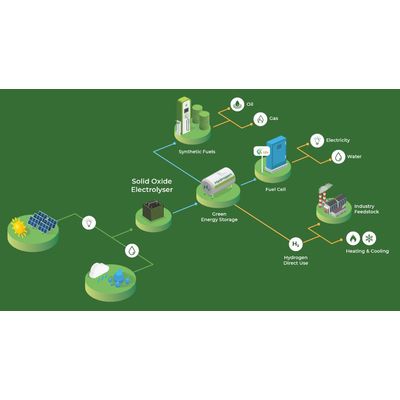
The surplus energy from renewable sources can be effectively stored in the form of chemical energy using our Soldi Oxide Electrolyser Cells (SOECs). SOECs are reversible solid oxide fuel cells that use ceramic electrolytes and are also referred to as Regenerative Solid Oxide Fuel Cells (R-SOFCs)
Most popular related searches
SOECs can be used to produce hydrogen (H2), Syngas Fuel (CO+H2) from the mixture of water and carbon dioxide and oxygen from carbon dioxide. They operate a high temperature, typically 600°C to 1000°C to allow electrolysis of water. The high temperature operation reduces the need of electrical energy required for the electrolysis and instead uses heat energy to split water & carbon dioxide.

Currently for green hydrogen production three electrolysis technologies are commercially available. Polymer Electrolyte Membrane electrolysis (PEM), Alkaline electrolysis and Solid Oxide Electrolysis (SOEC) have made remarkable strides for H2 production. SOEC could play a greater role because of the inherent advantages like highest efficiency, highest robustness, no precious metals required for manufacturing, stack made of ceramics which can be sources locally.

As per the below graphs on the tests conducted using a mPower 10 Cell Stack, through co- electrolysis approx. 1 Nm3 of Syngas can be produced from 3.1 kWh of Electricity. This is efficient than the PEM or Alkaline Electrolysers which needs 4-5 kWh electricity to produce 1 Nm3 of Hydrogen.

The SOEC UNIT uses mPower‘s Solid Oxide Electrolysis Cells (SOEC) technology, the most energy efficient electrolysis technology. The SOEC cells operate at high temperatures between 750 and 850 °C and ambient pressure. The thermoneutral operation of the SOEC UNIT eliminates the high cooling requirements typical for PEM (Polymer Exchange Membrane) and alkaline technologies.