Sontheim - Model eSys-SVC4 xt -Control System
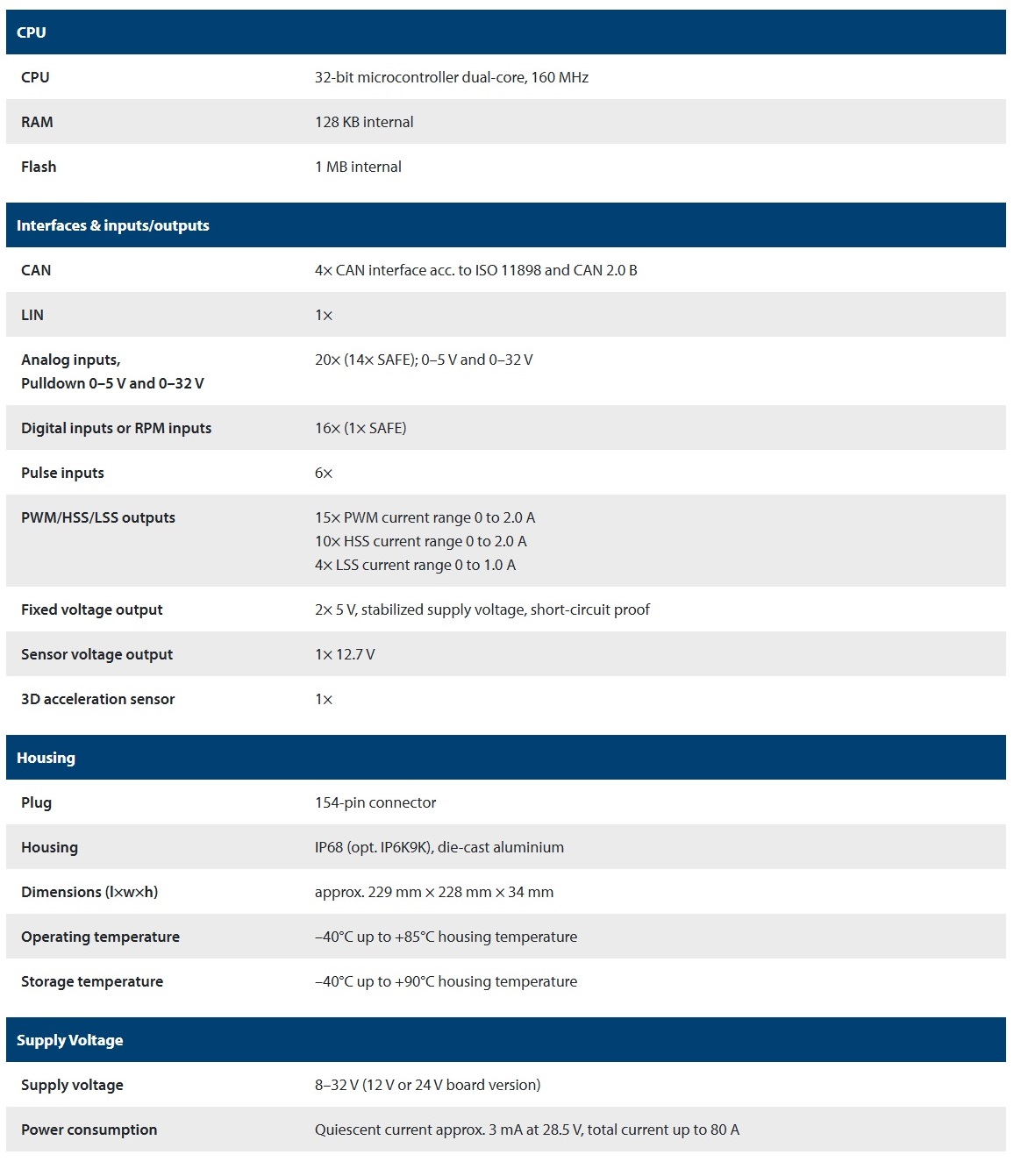
ASIL-C safety control with AUTOSAR-compliant software architecture, four CAN interfaces according to ISO 11898, one LIN and 74 inputs and outputs. eSys-SVCx product family: The Safety ECU family consists of two different high-end safety modules with different configuration options. The wide range of applications offers numerous possibilities for use in mobile machines such as trucks and trailers, as well as construction, agricultural and special-purpose machines.
Interfaces and safety-certified up to ASIL-C
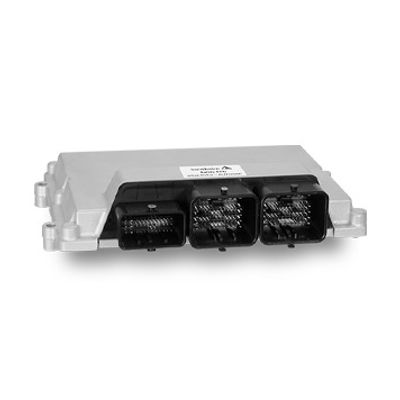
A powerful 32-bit dual-core microcontroller with 160 MHz, up to four CAN, one LIN interface and 74 IOs (including PWM current control) can be used for applications up to Automotive Safety Integrity Level C (ASIL-C). The risk classification is defined by the ISO standard 26262 for safety-relevant electrical/electronic systems in motor vehicles. The electronics are protected by a robust die-cast aluminium housing and robust automotive connectors facilitate the connection to the control unit.
AUTOSAR-compliant software architecture
The safety controllers are available with various software packages. Starting with QM (quality management) based software up to ASIL-C and AUTOSAR compliant software, you can choose which software architecture is required for your application. This flexibility allows you to use it for a wide range of applications and safety requirements.
It always provides the customer with the optimum Safety-ECU – optimized for the individual application and the best possible cost-benefit ratio.
The AUTOSAR standard (AUTomotive Open System ARchitecture)
AUTOSAR is an open and standardized software architecture for automotive ECUs (without infotainment). The architecture scales to different vehicle and platform variants, takes into account system availability and system safety requirements, and supports software transferability, sustainable use of natural resources, and ease of maintenance throughout the entire product life cycle.
Among other things you benefit from:
- Reduction of the number of ECUs in the vehicle by flexible assignment of ECU data with multiple functions
- Easier integration into the vehicle through a defined architecture
- Reusability of functions through fixed standards for important system functions and interfaces
- Easy scalability and expandability. This makes a functional development for smaller quantities interesting
- Function development possible, independent of the existing topology in specific vehicles