


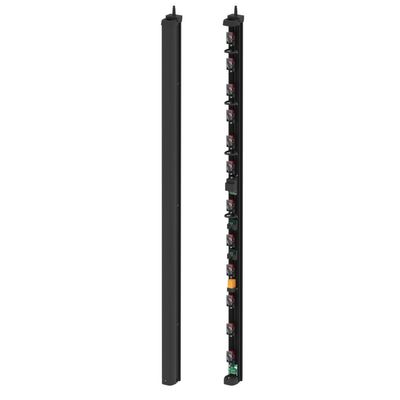
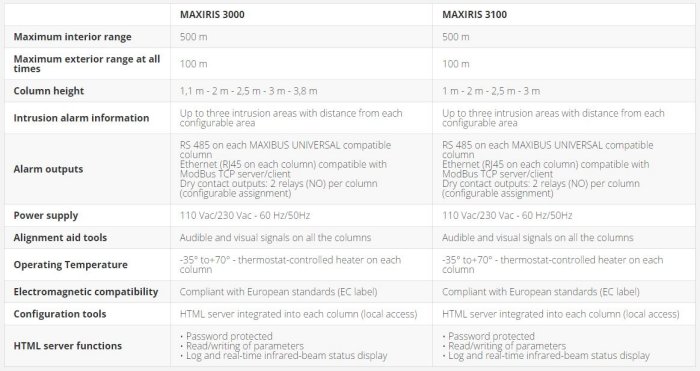
The MAXIRIS infrared barriers offer the highest level of performance of SORHEA products. In fact, for long perimeters (above 1 km), the MAXIRIS columns can be directly connected to a TCP/IP network or in RS485 bus via the MAXIBUS UNIVERSAL Hub.
Thanks to the ZONING function, up to three virtual detection zones can be created (configurable length) per barrier, optimising the video system (alarm information per zone) and, thus, reinforcing site reliability while guaranteeing a very high security level.
A multi-lingual HTML server, integrated into each column, can be used to carry out all the system configuration and maintenance operations.
The MAXIRIS technology and housing allow it to be installed on a wide variety of sites:
- logistics sites,
- particularly sensitive sites: prisons, nuclear power plants, military sites, etc.
- public places: airports, metros, etc.
- industrial sites, etc.
To use the barriers correctly, it is important to ensure that the barrier is not installed on an unstable support (e.g. badly sealed pole, etc.). Before installing an infrared barrier, check that the ground is quite level and will guarantee the stability of the columns with time. A maximum of 10° elevation may be tolerated between the columns. In case of elevation above 10°, contact SORHEA’s sales department.
Check that no vegetation can block the beams, no matter the season and weather condition (wind).
It is also important to check the cleanliness of the covers: it is important to clean them with a soft and damp cloth at least once a year.
This technology works at a wavelength above that of visible light (950nm), which makes the IR beam invisible to the naked eye.
The infrared beams are transmitted and received by infrared cells. The transmitter cellsgenerate a pulsed beam that is sent towards the receiver cellswhich capture the infrared pulses and transform them into electrical signals. In the absence or variation of the signal (loss of 95% of the transmitted signal), an intrusion alarm is triggered. To prevent the receiver cells from being interfered with by the transmitted infrared beams thecells are multiplexed.
This principle consists in transmitting an infrared pulse in a synchronised manner, via an optical or wired link between the transmitter and receiver columns. This feature is also used to optimize the alignment of the cells (“alignment feedback”). All the SORHEA IR barriers are multiplexed (except UNIRIS II & BIRIS II).