


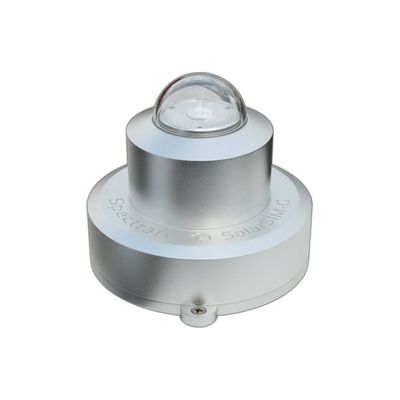
Spectrafy - Model SolarSIM-G -Spectral Irradiance Sensor
The SolarSIM-G sets a new standard is solar spectral measurement. The first, and only, sensor capable of resolving full-range solar spectra and broadband irradiance, the SolarSIM-G employs Spectrafy’s patented SolarSIM multi-spectral measurement technology to bring routine solar spectral measurement to any application where the highest quality of irradiance data is desired.
- Measurands: Global solar spectral irradiance (280 to 1200/4000nm), Global solar irradiance (GHI and/or GTI), PAR, UV-T
- Technology: Software-augmented multi-filter radiometer.
- Highlights: Full range spectra and broadband irradiance in one. Makes spectral measurement reliable, routine and affordable.
- ISO9060:2018: Class A, spectrally flat for sunlight, fast-response optional.
For applications where measurement of the global solar spectrum is a must, the SolarSIM-G sets a new standard for accuracy, affordability and ease of use.
The SolarSIM-G uses filtered photodiodes to make precise, multi-spectral measurements of the solar spectrum in several narrow wavelength bands. These measurements then inform the SolarSIM-G’s software to resolve the complete global solar spectrum and total global irradiance, under all sky conditions.
This innovative approach makes the SolarSIM-G the first, and only sensor capable of resolving global spectral solar irradiance over the full 280-4000nm range, from which various other irradiance components such as GHI, UV-T and PAR can also be obtained.
Applications for the SolarSIM-G include solar R&D, solar resource assessment, PV panel development and certification, PV plant operations, UV measurement networks, agricultural monitoring, material testing and even multi- and hyper-spectral imaging.
- The SolarSIM-G can generate up to 20 high-quality data streams. Choose what you need:
- Global horizontal (or tilted) irradiance : ISO9060:2018 Class A measurements of global irradiance (horizontal or tilted), under all sky conditions, covering the complete 280-4000nm solar spectral range.
- Global horizontal (or tilted) spectral irradiance : Solar spectral irradiance (horizontal or tilted), under all sky conditions, over the complete solar spectral range of 280 – 4000nm, with 1nm resolution.
- Spectral correction factors for PV : Automated calculation of spectral correction factors for up to nine embedded or user-defined solar panels.
- Ultra-violet irradiance : UV-A, UV-B, UV-T, UV-E and UV index.
- Photosynthetically active radiation : Total irradiance within the 400-700nm wavelength range.
- Meteorological parameters : Ambient temperature, relative humidity and atmospheric pressure.
The only UV sensor you`ll ever need.
- Public health : UV irradiance can significantly damage human skin, resulting in sun burn, premature ageing and even some forms of cancer. Widespread deployment of UV sensors help the public understand local UV conditions in real-time.
- Agricultural monitoring : Ultraviolet light is known to have adverse effects on plants and animals. UV measurement networks allow industry an researchers to quantify and predict the effects of naturally occurring UV light on our food chains.
- UV load monitoring for material testing : Accurately quantifying the UV exposure of new materials and coatings during outdoor testing provides important insights into their real world performance.