


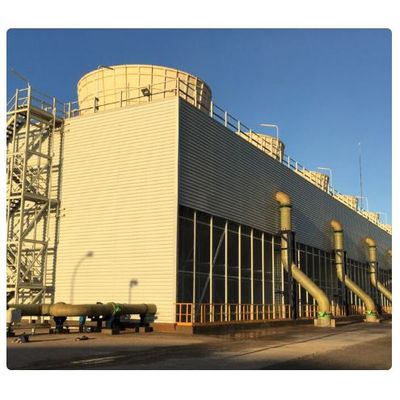
SPIG - Wet Cooling Towers
SPIG natural draft and induced or forced draft wet cooling towers are designed for a wide range of project requirements such as high seismic and wind loads, vibration control, corrosion resistance, low-noise emission, sub-freezing operation and fresh, geothermal, sewer or sea water applications. Cooling tower structures can be customized using fiber reinforced polymer (FRP), precast or cast in situ concrete, steel or wood.
SPIG natural draft and induced or forced draft wet cooling towers are designed for a wide range of project requirements such as high seismic and wind loads, vibration control, corrosion resistance, low-noise emission, sub-freezing operation and fresh, geothermal, sewer or sea water applications. Cooling tower structures can be customized using fiber reinforced polymer (FRP), precast or cast in situ concrete, steel or wood.
SPIG hybrid cooling towers offer an environmentally friendly solution for plume abatement and water conservation. Specifically designed to eliminate visible plumes in cold, humid conditions and meet local regulatory requirements, such as at airports or residential areas, these towers excel in cost-effectiveness and performance. By integrating wet cooling tower technology with dry heat exchangers, SPIG’s hybrids effectively minimize environmental impact.
The dry sections, featuring conventional air-cooled heat exchangers positioned above drift eliminators, use triangular pitch tube bundle designs with fins for optimal efficiency.
This hybrid design combines dry and wet cooling within a single structure. Hot water flows through the system sequentially, starting hot in the external dry section above the drift eliminators, then pre-cooled before distribution onto the wet section’s fill media. A skid vacuum system ensures the siphon effect in the tube bundles (dry section), reducing the workload on circulating water pumps.
Hybrid cooling towers are particularly advantageous where water usage must be minimized and visible plumes avoided, which can be disruptive in sensitive environments like air traffic or residential areas. While wet cooling towers may offer initial cost savings, hybrids provide long-term environmental benefits by reducing water consumption and plume emissions. In many cases, the water savings achieved with hybrid technology outweighs the initial construction costs.
With over 85 years of experience, our company’s expertise in wet and dry applications spans more than 85 countries, showcasing our commitment to excellence and innovation. Each installation is a testament to the skill and dedication of our engineers, who design solutions that perform reliably across diverse industries, including power generation, petrochemicals, and manufacturing. Our global presence reflects our ability to meet the most demanding challenges, delivering high-performance systems that enhance thermal efficiency and sustainability. These references underscore our enduring legacy of quality, innovation, and long-term partnerships with clients worldwide.
Our experience includes wet cooling (mechanical and natural draft) systems, dry cooling systems and hybrid cooling solutions as dictated by site-specific requirements. We design plants for a wide range of project requirements such as high seismic and wind loads, vibration control, corrosion resistance, low-noise emission, sub-freezing operation, and seawater applications. Specialized services include preventive maintenance, equipment upgrades, replacement and spare parts, online performance monitoring, and a commitment to research and develop efficient cooling system solutions.