

- Home
- Companies
- Jignesh Steel
- Products
- Jignesh - Model ASTM A194 8M - ...
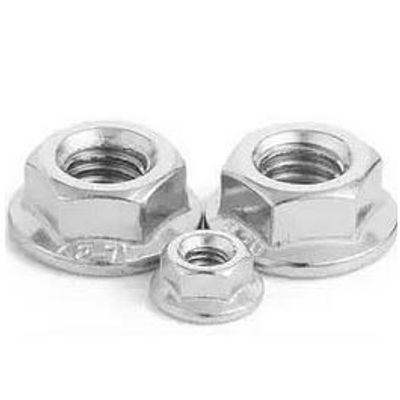
Jignesh - Model ASTM A194 8M -Stainless Steel Flange Nut
All types of ASTM A194 8M Serrated Flange Nut and Stainless Steel 304 Flanged Weld Nuts manufacturer in India. Flange Nut acts as an integrated washer it is a nut that has a wide flange at one end. This distribute the pressure of the nut over the part being secured which reduces the chance of damage to the part and makes less likely to loosen as a result of an uneven fastening surface. These nuts are mostly hexagonal in shape.
Stainless Steel Flange Nuts are used to spread the load evenly to avoid uneven fastening surface of the operations. It also ensures that the fasteners are in place without moving about loosely. Stainless Flange Nut has a flange at the bearing face that eliminates the need for a washer and spreads the surface loading. The lower side of the flange is usually plain but can have radial serrations that provide a locking action on the bearing surface. Stainless Steel Serrated Flange Nuts are hex nuts with non-spinning washers that is attached at the bottom. On a serrated flange nut, the serrations are angled in such a way that it keeps the nut from rotating in the direction that can loosen the nut. Since the serrations cannot be used with a washer or on surfaces that must not be scratched. The serrations help in preventing the vibration of the nut from moving the fastener, thus it continues to hold the power of the nut.
Flange Lock Nut is one piece, all-metal prevailing torque hex flange nuts. The protruding circular flange increases the nut`s bearing surface which allows them to be used with oversized and irregular holes. It is useful in commercial and industrial applications including truck manufacturing and lawn and garden equipment. Hex Flange Nut is a hex nut with a wide flanged portion near one end that acts as an integrated non-spinning washer. It is utilized to spread the load placed on the nut over a wider surface area to prevent damage to the installation material. It is very common and widely used in softer attached materials.