


- Home
- Companies
- Kobs India
- Products
- Kobs - Model ANSI B 16.5, ASME B 16.47 ...
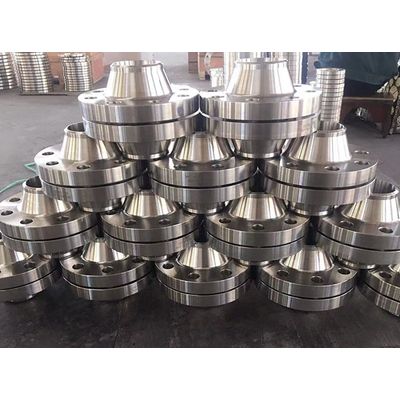
Kobs - Model ANSI B 16.5, ASME B 16.47 -Stainless Steel Weld Neck Flanges
ANSI B 16.5, ASME B 16.47 Stainless Steel Weld Neck Flange, of ASTM A182 Stainless Steel 304/304L Weld Neck Flanges, Exporter of Stainless Steel 317/317L Raised Face Weld Neck Flanges, MSS SP44 Stainless Steel ANSI 150 Weld Neck Flanges Stockist.
Of Stainless Steel 304/304L Weld Neck Flange, Stainless Steel 317/317L Weld Neck Flange Supplier, Stainless Steel 310 Weld Neck Flanges Exporter, Stainless Steel 347/347H DIN 2642 Weld Neck Flanges in India. Weld Neck Flanges have a long tapered hub and are often used for high pressure applications.
When ordering a weld neck flange, it is important to specify the schedule pipe is being used for. This is because the inside diameter of the flange will match the inside diameter of your pipe. The buttweld joint this flange has with the pipe along with the tapered hub, makes this flange very resistant to dishing and a very sturdy connection. These flanges are ideal for extreme fluctuations of temperature and in environments where there may be a lot of bending and handling of the flanges.. Welding Neck Flanges are easy to recognize at the long tapered hub, that goes gradually over to the wall thickness from a pipe or fitting. The long tapered hub provides an important reinforcement for use in several applications involving high pressure, sub-zero and / or elevated temperatures. The smooth transition from flange thickness to pipe or fitting wall thickness effected by the taper is extremely beneficial, under conditions of repeated bending, caused by line expansion or other variable forces. These flanges are bored to match the inside diameter of the mating pipe or fitting so there will be no restriction of product flow.
This prevents turbulence at the joint and reduces erosion. They also provide excellent stress distribution through the tapered hub and are easily radiographed for flaw detection. Weld neck pipe flanges are typically provided with a raised face, flat face, or RTJ facing. When a raised face is necessary for weld neck pipe flanges, the standard height is 1/16" for weld neck pipe flanges under 400 ( 2.4360)#. For weld neck pipe flanges of 400 ( 2.4360)# and up, the standard weld neck pipe flange raised face height is 1/4".
These pipe flanges attach by welding the pipe to the neck of the flange. This transfers stress from the flange to the pipe instead. It also reduces the stress concentration from the base of the hub. Weld neck flanges are often used for applications where high pressure is a factor. The inside diameter of the flange is designed to match the pipe`s inside diameter. Weld Neck Pipe flanges with a hub have published specifications that range from 1/2" thru 96". Our company provides these in all material grades, specifications and sizes.
B16.5 ASTM A182 Weld Neck Flange, Fusion Bonded Epoxy Coating, EN 1092-2 PN16 Weld Neck Flange, ASME B16.5 Dual Stainless Steel Weld Neck Flange, ANSI B16.5 Class 150 Flat Face Weld Neck Flange, Stainless Steel 317/317L 30 Inch Weld Neck Flange Stockiest.
Manufacturing Process :
The manufacturing process of flange mainly is divided into forging, casting, cutting and rolling. .
The casting and forging flanges have advantages that the blanks of them have accurate shape, size and low costs and only need simple process. But forging flanges have manufacturing defects such as blowholes, cracks, etc and have not very smooth internal organization streamline. The obvious advantages of forging flanges are that they can be forged in various shapes and they have low costs. .
Forging flanges generally have lower carbon content than the casting flanges and are not easy to rust. They have smooth streamline, uniform internal organization, and better mechanical performance than that of casting flanges. There are no defects, such as blowholes and cracks existing in the casting flanges. Forging flanges are able to withstand higher shear and drawing forces than casting flanges. However, if adopting improper forging process, it will also cause appearance of large, uneven grains and solidification cracking phenomenon, resulting in higher cost than the casting flanges. .
We can distinguish between the casting flanges and forging flanges from the different production process. To take the centrifugal flange as an example, it is a kind of casting flange. Centrifugal flanges are produced by a precision casting method, which makes the flanges’ organization smaller than those commonly produced by sand casting and improves the quality of flanges, making fewer occurrences of loose tissue, pore, sand hole etc.
Cutting process refers to producing flanges by directly cutting a round plate with the inner diameter, outer diameter and thickness which can be further processed later from the middle plate, and then processing the bolt hole and waterline. The maximum diameter of such flanges is limited by the width of the middle plate.
Cutting process refers to producing flanges by cutting stripes from the middle plate and then rolling them into round shape. This process is mainly used for the production of large flange. After the rolling process, weld and then flatten the round shape, and finally process the serrated spiral finish and bolt hole.
- Size : 1/2" to 48"
- Specifications : ASTM A182
- Rating: 150#, 300#, 600 (2.4640)#, 900#, 1500#, 2500#,
- Sturdy design
- Accurate dimensions
- High strength
- Corrosion resistant
- Smooth transition from flange thickness to pipe
- Can be easily radio graphed for flaw detection
- Can be easily welded to a pipe or fitting with a single full penetrations
- Duplex Steel: Grade: 2205 (1.4507)
- Nickel :Grade: Nickel 200, Nickel 201
- Super Duplex Steel: Grade: 2507 (UNS S32750) (1.4410) (UNS S32750), Z100
- Inconel : Grade: Inconel 600 (2.4640), Inconel 601 (2.4851), Inconel 625 (2.4856), Inconel 718(2.4668)
- Titanium : Grade: Gr.1 (3.7025) , Gr.2 (3.7035) , Gr.3:(3.7055) , Gr.5(3.7164/65), Gr. 7(3.7235) , Gr. 11 (3.7225)
- Monel : Grade: Monel 400 ( 2.4360), Monel K500, Monel R-405
- Hastalloy : Grade: Hastalloy B2, Hastalloy B3, Hastalloy C22, Hastalloy C276, Hastalloy X
- Incoloy : Grade: Incoloy 800 (2.4958), Incoloy 800H, Incoloy 800HT
- Useful in Paper & Pulp Companies
- Useful in High Pressure Applications
- Useful in Oil and Gas Industry
- Useful in Chemical Refinery
- Useful in Pipeline
- Useful in High Temperature Application
- Useful in Water Pipe Line
- Useful in Nuclear Power Plants
- Useful in Food Processing and Dairy Industries
- Useful in Boiler & Heat Exchangers
- Packing is quite important especially in a case of international shipments in which consignment pass through various channels to reach the ultimate destination, so we put special concern regarding packaging.
- We pack our goods in numerous ways based on the products. We pack our products in multiple ways, such as,
- Shrink-wrapped
- Carton boxes
- Wooden pallets
- Wooden boxes
- Wooden crates