

- Home
- Companies
- HOLOEYE Photonics AG
- Products
- HOLOEYE - Standard Diffractive Optical ...
HOLOEYE - Standard Diffractive Optical Elements
HOLOEYE Photonics AG specializes in the development and supply of Diffractive Optical Elements (DOEs), which serve as critical components in laser systems and optical setups. These elements are engineered using advanced methods in polymer replication and glass etching. The standard polymer DOEs are crafted from polycarbonate or polymethyl methacrylate and possess a typical diameter of 8 mm, designed to fit seamlessly into standard laser modules. Meanwhile, the standard glass DOEs are composed of etched fused silica or arylate-on-soda-lime glass, providing enhanced precision and sustainability in optical applications. This broad range of DOEs, including both polymer and glass types, caters to various optical needs, from simple beam splitting to complex multi-pattern generation. HOLOEYE also offers customization options to tailor these components to specific application requirements, backed by an efficient non-recurring engineering budget.
Our standard polymer Diffractive Optical Elements (DOE Category I) are crafted through surface replication using materials such as polycarbonate (PC) or polymethyl methacrylate (PMMA).
These elements, with a standard diameter of 8 mm and a thickness between 0.6mm and 1.2mm, are designed to seamlessly integrate into various standard laser modules.
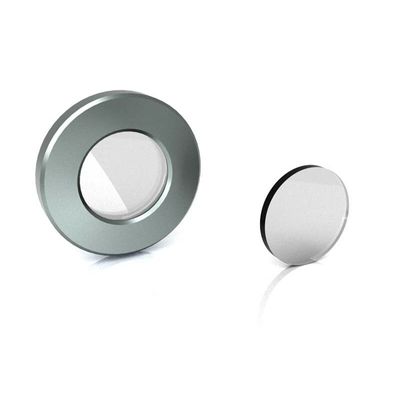
For use in the optics lab, the DOEs are also available mounted in a 12.7 mm x 2.2 mm stainless steel adapter ring.
HOLOEYE’s standard DOEs empower laser module manufacturers and distributors to enhance their product lines with minimal investment. We welcome requests for size adaptations or other customizations, which will be provided based on a reasonable Non-Recurring Engineering (NRE) budget.
Our standard glass DOEs are made of fused silica glass by etching, or are replicated using acrylate on soda-lime glass substrates. In sample quantities, all size versions are available in circular holders for easy use with standard optics mounts.
Advantages of Glass DOEs Compared to Polymer-Based Diffractive Optical Elements:
- Durability: Glass DOEs are more rugged and scratch-resistant.
- Thermal Stability: They have lower thermal expansion coefficients (CTE).
- UV Resistance: They can withstand exposure to UV radiation without degradation, and can be used with UV lasers.
- Heat Resistance: They can endure significantly higher temperatures.
- Laser Power: They can handle significantly higher laser powers.
- AR Coating: They have anti-reflective coating on at least the plain surface side, several types on both surfaces
- Polarization-maintaining: They have negligible birefringence in the substrate.