


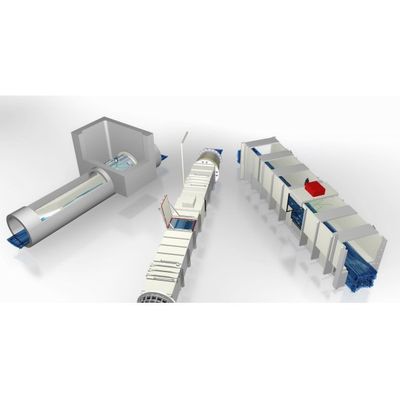
Stebatec - Model TF -Stationary Flow Measurement System
The TF stationary flow measurement partially filled is a calibrated measuring channel for backflow-free flow measurement of wastewater, raw sewage and rainwater in open channels or in gravity pipes. The need for user-pays cost accounting is also increasing in the wastewater system. Especially in view of the increasing demands on precise measurement and control technology, the STEBATEC measuring system offers significant advantages for stationary, partially filled flow measurement.
Reliable measurement results – thanks to the dry weather channel
Because flow meters often cannot measure low water levels, the precise measurement of very small quantities in wastewater flow measurement technology is generally considered a challenge. The purpose of the adaptable channel shape from STEBATEC is therefore to provide a device in order to be able to measure flow rates in partially filled (open) sections, e.g. channels, but also in closed sections, e.g. pipes, even with (very) low discharge. Thanks to the “dry weather channel” on the partially filled stationary flow measuring system, the water level and flow velocity can still be measured in these cases. In addition, the dimensioning of the rainwater channel can also be done individually, so that the device cross section can be adapted to the amount of water generated, which results in optimal measuring conditions. The rectangular shape was chosen
Three different construction methods
The stationary flow measurement partially filled TF is offered in the following three versions:
- wet exhibition; Open at the top and without a connection to the downstream line on the drain side
- dry installation; closed with maintenance openings
- In-line construction; in pipes and channels with a diameter >1.5m
The partially filled stationary flow measurement was designed for integration into existing structures. Not only can the shape of the channel be adapted to the volume of water generated, but various adapters are also available for connection to the existing infrastructure. (See document: Technical documentation)
Measuring principle of the ultrasonic transit time difference
Ultrasonic flow meters measure the speed of a flowing medium using acoustic waves. To put it simply, consider two boats crossing a river diagonally on the same line; one in the direction of flow and the other against the flow. The boat moving in the direction of the current takes a much shorter time to reach the opposite bank. The same applies to ultrasonic waves. A sound wave propagates faster in the direction of flow of the measured medium than the sound wave in the opposite direction. The running times are measured continuously. The difference in transit time between the two ultrasonic waves is therefore directly proportional to the average flow speed. The flow volume per unit of time is the result of the average flow velocity, multiplied by the respective pipe or duct cross section. Acoustic flow measurement offers several advantages over other measuring methods. The measurement is largely independent of the properties of the media used, such as electrical conductivity, density, temperature and viscosity. The lack of moving mechanical parts reduces maintenance costs and there is no pressure loss due to cross-sectional narrowing. A large measuring range is one of the further advantages of this process. The lack of moving mechanical parts reduces maintenance costs and there is no pressure loss due to cross-sectional narrowing. A large measuring range is one of the further advantages of this process. The lack of moving mechanical parts reduces maintenance costs and there is no pressure loss due to cross-sectional narrowing. A large measuring range is one of the further advantages of this process.
Reliable and precise measuring system
Local conditions such as hydraulics, channel roughness and channel slope do not influence the measurement accuracy because, thanks to the calibrated measuring channel, the hydraulic conditions are specifically ideal for measurement purposes. In combination with sensors that are difficult to manipulate due to solids and deposits, optimal measurement quality is achieved.
Accurate and easy to maintain
- Guaranteed and controllable measurement accuracy >99%
- Internally calibrated measuring section
- Reliable, very difficult to manipulate and influence by solids, deposits or external influences
- Also works when there is a backlog
- Maintenance and cleaning is easy because the device is open at the top or easily accessible via maintenance openings.
- Backflow-proof, emergency overflow
- Long service life – no wearing parts
- Mostly fits into existing buildings – no conversion necessary
- Large measuring range thanks to individually adaptable channel shape
- Installation possible without water diversion
- Assembly usually possible in 1 day
Versatile – for communities and companies
- Nominal width construction methods wet and dry installation: NW200 to NW1200
- Nominal widths in-line construction: NW1500 to NW3000
- Installation with hanging adapter or slide plate adapter for easy removal during maintenance work
- Quantity recording in municipal wastewater associations
- Quantity measurement on sewage treatment plants on the inlet and outlet side
- Wastewater leakage control for industrial companies
- Measuring drainage water
- Mining and process water measurements in mining and tunnel construction
- Expense accounting measurement
- Extraneous water measurement
- Rainwater measurement