


- Home
- Companies
- LANXESS Deutschland GmbH
- Products
- LEWATIT - Model VP OC 1026 - ...
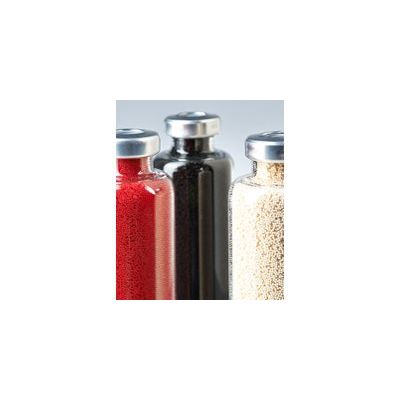
LEWATIT - Model VP OC 1026 -Styrene-Divinylbenzol Copolymer Containing Di-2-Ethylhexyl Phosphate (D2EHPA)
Lewatit® VP OC 1026 is a macroporous resin based an a styrene-divinylbenzol copolymer containing di-2-ethylhexyl phosphate (D2EHPA). This extracting agent is already included directly during the polymerization, which leads to a high concentration of the active ingredient. In addition, a loss of extractant during operation is minimized (as long as the pH of the process solution as well as rinse water ist kept below pH 4).
Cations are adsorbed by Lewatit® VP OC 1026 in the following order: Ti4. > Fe3+ > In3. > Sn2,4+ > Sb3` > Bi 3` > V02" > Be2" > Al3" > Zn2" > Pb2" > Cd2" > Ca2" > M n2" > CIF" > Fez" > CO2" > Ni2" > Mg2" > Cr+ > > Alkali
Fields of application:
lt can generally be assumed that Lewatit® VP OC 1026 those components receives from aqueous solutions, which can be removed by means of the liquid extractant D2EHPA from sulfur and hydrochloric acid solutions as a function of pH, e.g.:
- divalent ions of zinc, uranium (UO2-), vanadium (VO-)
- trivalent ions of lathanides, indium, iron, aluminium
- tetravalent ions of actinides, titanium
Advantages of Lewatit® VP OC 1026 compared to solvent extraction:
- no organic solvent required
- no phase separation problems
- simple equipment similar to conventional bead type ion exchange resins
Important hints for application:
There is a marked distinction in its physical and chemical properties from those of the known ion exchange resins. The product data summarized in the following pages should be carefully observed. lt has to be emphazised that: The active ingredient of Lewatit® VP OC 1026 is in the form of the acid ester. This means that the form supplied can be directly used. Exposure to sodium hydroxide or sodium carbonate should be avoided since the active ingredient will be displaced from the resin. Also the pH of process solution and rinse water should always be < pH 4. The resin is floating to the liquid surface. Therefore the column should be equipped with an adequate distribution plate at the column`s head and be operated upstream.
Due to the specific method of manufacturing the resin has a relatively high percentage offine beads. Therefore it is recommended to use inert resin (Lewatite IN 42) to protect the head distributor against plugging. To protect the bottom distributor a gravel Iayer can be applied.
Backwash can only be carried out in downflow mode by means of an acidic, in minimum 4 % salt containing solution. Backwash water is discharged through a special outl pipe positionned below the ion exchange bed.
The resin can be used without backwashing only in the case that a thorough - pre filtration is carried out. In this case the column is designed with a packed bed, having only 10 % freeboard.
Information
- Business Unit: Liquid Purification Technologies
- Product Group: Anionic
Applications
- Extraction
- Metal industry
- Pharmaceutical industry / Biotechnology
- Purification
- Recycling
- Rinse water
- Water Treatment
- Industrial water
- Mining
- Process water
- Recovery
- Removal
- Separation
Synonyms
- Lewatit trial product OC 1026
- Lewatit VP OC 1026