


- Home
- Companies
- Sequoia Scientific, Inc.
- Products
- Sequoia Scientific - Model LISST-ABS - ...
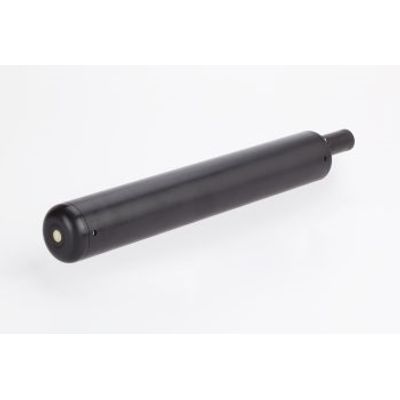
Sequoia Scientific - Model LISST-ABS -Submersible Acoustic Backscatter Sediment Sensor
Low-cost acoustic sensor directly measuring Suspended Sediment Concentration (SSC) at a point. Integrates easily with existing dataloggers or monitoring systems. Typical application areas: Environmental monitoring where SSC is of interest, hydropower, sediment studies. Sequoia is in discussion with potential parties that may take over production and are evaluating the technology and market. Sequoia will continue production until a decision has been made in this regard. Units are in stock for immediate delivery and Sequoia is still taking orders.
This is a new type of sediment sensor, superior to optical backscatter sensors (OBS) for 4 reasons.
- The 8MHz acoustic sensor ‘sees’ all size grains, and unlike OBS, it sees coarse grains very well.
- The LISST-ABS calibration is far less sensitive to grain size changes than OBS sensors, changing only ~ ± 30% over 30-400 microns (see Application Note).
- Operates over a ~5-decade working range in concentration!
- Tolerates fouling.
The LISST-ABS is easy to integrate into existing sensor platforms. Click here for simple version of how it works, or here to get a detailed explanation.
- Output: Backscatter signal strength in decibels as volts or digital value (formula provided for conversion to concentration)
- Sample Volume Location: 5.5 cm from sensor face.
- Operating Frequency: 8MHz
- Tolerant to biofouling
- Calibration over 30-400 micron sizes: flat to within ±30%; [compare with ±400% for optical turbidity sensors]
- Calibration for fine particles below 30 microns: response follows d^1.5
- Analog, SDI-12 and Digital (RS232) outputs available on the underwater connector
The LISST-ABS is a single-point monitoring sensor. It uses a new and novel technique to internally compensate for geometric beam spreading and attenuation, yielding de-attenuated backscatter signal strength. It is held pointing into flow for low drag.
Why acoustics? Why single-point, and why 8 MHz?
Acoustic sensors benefit from their much higher tolerance to fouling than optical sensors, which is an obvious advantage. Single-point use makes them suitable for monitoring wherever turbidity type sensors are in use. The choice of 8MHz frequency is made to ensure nearly flat response to particles in the size range 30-400 microns.
For example, LISST-ABS maintains calibration over a size range 30 to 400 microns within ~ ±30% from its mean value (thin black line). In contrast, sensitivity of optical turbidity sensors changes by ~ ±400% over the same size range.
Technical:
- 8 MHz
- Sample Volume: 10 dia x 15 L (mm) (located 5.5 cm in front of sensor)
- Resolution: 0.5 % of reading
- Outputs:
- 0-4 V analog (logarithmic, 0.5 V/decade covering 100 g/l)
- SDI-12
- RS-232
- Range: 1 mg/L to 30 g/L (7 micron dust) or <20 g/L (200 micron sand)
- Calibration: Recommended with sediment samples
Mechanical and Electrical:
- Sensor Dia.: 2.00 in (5.08 cm)
- Length: 13.25 in (33.65 cm)
- Weight: 1 lb. (0.5 Kg) in air; 0.5 lb. (0.22Kg) buoyant in water.
- Transducer: 8 mm dia, ceramic
- Power supply : 9 to 18 VDC, 100 mA
- Max. Depth: 100 m (check with factory for deeper rating)
- Material: ABS Plastic
- Connector type: Impulse MCBH-8-MP-SS
- Power on LED: Green, blink on update
- Sample update rate: 1Hz [average of 1000 measurements]