
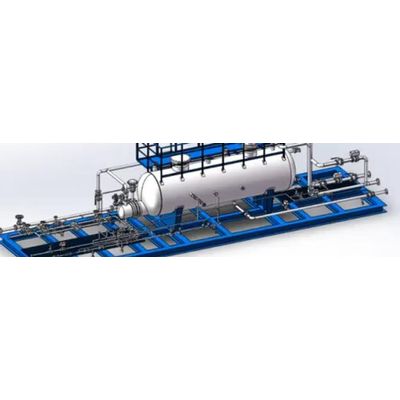
The E-impeller design optimizes the mixing and kneading of high viscosity materials by providing enhanced shear and dispersion. Ideal for processing polymers, resins, and other viscous materials where uniform mixing and thermal control are critical.
The E-impeller design optimizes the mixing and kneading of high viscosity materials by providing enhanced shear and dispersion. Ideal for processing polymers, resins, and other viscous materials where uniform mixing and thermal control are critical.
, a kind of full-wet process for pre-treating of plumbous zinc ore comprises that immersion, removal of impurities, precipitation separate out and separate, and it is characterized in that:
(1), nitric acid dousing
Ore is through being crushed to below 75 microns, with rare nitric acid dousing of 5N 2.5~3.0 hours to the final acidity control of soak solution at 5~12 grams per liters, get filtrate after the filtration;
(2), removal of impurities
The ammoniacal liquor that in filtrate, adds 5~8N, to the pH value of filtrate be 4.1~5.2, separate out Fe (OH) 3, Fe (OH) 2, and reddish-brown and the yellowish brown flockss such as oxyhydroxide of As, Sb, filter, filter residue is made other purification processes;
(3), separate out plumbous zinc precipitation
Continuation adds the ammoniacal liquor of 5~8N in filtrate, be neutralized to pH value in the filtrate between 8.5~9.5, separates out Pb (OH) 2, Zn (OH) 2Faint yellow precipitation, after the filtration, filtrate gets NH after evaporation 4NO 3, filter residue is mainly the oxyhydroxide of Pb, Zn;
(4), plumbous and zinc separates
Continue to add excessive ammonia in filter residue, throw out is partly dissolved, and filters, and the throw out that leaches is Pb (OH) 2, filtrate is the complex compound of Zn;
Add the dilute sulphuric acid of 5N in the precipitation of hydroxide of Pb, Zn, be partly dissolved, after the filtration, filtrate is ZnSO 4Filter residue is PbSO 4
The precipitation of hydroxide of Pb, Zn is soaked with HCl, the partly precipitated dissolving, and after the filtration, filter residue is PbCl 2, filtrate is ZnCl 2
- Effective self-cleaning to minimize dead zones, product accumulation and product degradation
- Excellent kneading and mixing for better homogenization
- Effective heat transfer
- High surface renewal efficiency
- Large free vapor volume
- Precise and uniform temperature control due to large heat transfer areas
- Continuous or batch processing
- Process intensification
- Processing of sticky and highly viscous products
- Residence time is independent from agitator speed, wide and flexible range of average residence times
- Reliable process scale-up from pilot to industrial units
- Large production capacities, economy of scale
- Maximum process yield per unit volume
- Reliable, robust design
- Short return of investment