


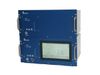
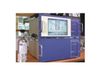
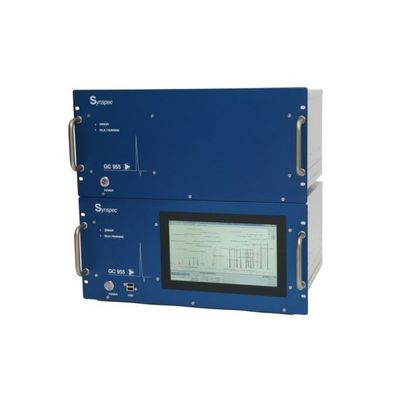
Synspec - Model GC955 611/811 -Ozone Precursor Hydrocarbon Analyser
Ozone precursors measurement in the ambient air. Synspec GC 955 series 611/811 is a combination of two gas analysers for online continuous monitoring of ozone precursors in the ambient air. GC 955 811 is specifically designed for the measurement of the hydrocarbons from C2 up to C5 and the model 611 for the hydrocarbons from C6 up to C12. With the combination of these two GCs nearly all of the compounds from the US EPA PAMS list can be measured continuously and online with a high accuracy.
Analyser for measurement of hydrocarbon ozone precursors in ambient air.
Ozone is one of the most reactive substances in ambient air. In the stratosphere it has a protecting function as it will filter the strongest sun radiation. But in the troposphere, the lowest layer of the air, it can be harmful for humans, agriculture and nature in general. Ozone is formed naturally but could also generate from reaction of nitrogen oxides with hydrocarbons in certain atmospheric conditions. The production of ozone happens faster under strong sun radiation, high temperature and high humidity. The products of these reactions are photochemical smog, containing not only ozone, but also very toxic hydrocarbons and fine dust particles.
- Synspec GC 955 series 611/811 ozone precursor analyser can measure up to 80 components.
- The ozone precursor measurement is done by a combination of two analysers that enables measurement of all components.
- For hydrocarbons with higher boiling points (BP range > 50oC ), a trap with a low memory effect and a column, suitable for separating species present in this BP range, are used.
- For the low boiling hydrocarbons, a cooled trap and a column that is dedicated to separate the low boiling hydrocarbons, are used.
It is important to monitor hydrocarbons that are emitted into the air and to focus on those that have a major effect on the ozone formation.
At the moment the USA has defined a group of 58 hydrocarbons while the EU has defined a list of 28 hydrocarbons. The first list is responsible for ca. 90%, the second for ca. 80% of ozone formation. Knowledge of the main precursors for ozone formation is developing. A revision of the compound lists is made from time to time. In other areas of the world other compounds may be more important. Hydrocarbons emitted by nature must also be included.
The equipment is capable of measuring hydrocarbons that do not contribute to the formation of ozone, but that are toxic (e.g. chlorinated solvents). Including these solvents means that the equipment is used more effectively.
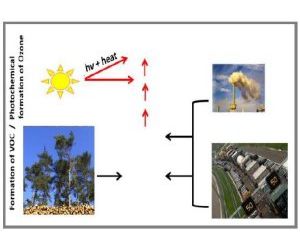
GC955-611 analyser measures a group of hydrocarbons that are predominantly sourced from fossil fuels. The sources are refineries, evaporation during transport and incomplete burning. The list contains one carcinogenic compound — benzene. A few of the compounds are being investigated as suspected carcinogens. Some compounds can cause long term damage to liver or brains. All of the compounds, except for benzene, function as ozone precursors, which is the main reason for monitoring.
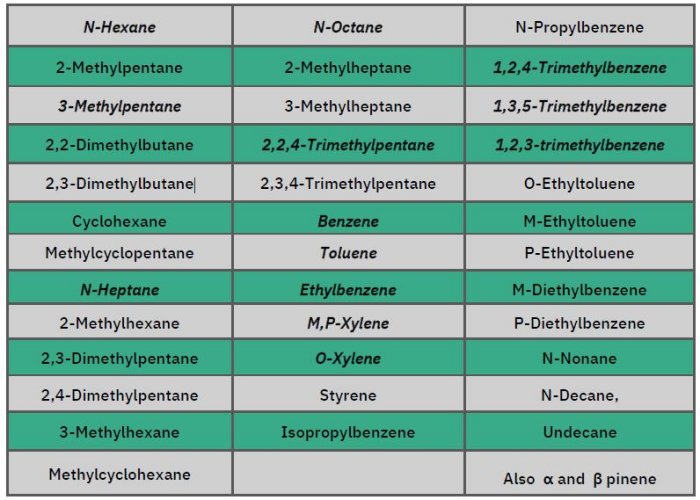
In the list below all USA EPA C6 to C12 compounds are shown. The compounds, which are also selected by the EU, are marked in bold.
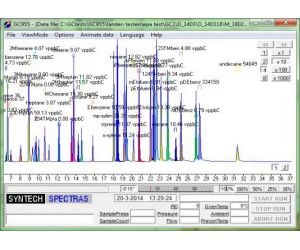
Online measurements show concentrations from detection limit (<0.1 ppb ) up to over 20 ppb. Daily concentration variation of one compound is often a factor 4. Hydrocarbons are not only emitted by traffic, but also by industrial or household processes.
The semi-continuous analyser of Synspec can follow these changes easily with the 30-minute cycles. A one hour cycle is also possible on request.
The hydrocarbons are concentrated inside the system to reach a low detection level.
The detector used is a photo ionization lamp: the detector is sensitive to all the hydrocarbons on the list. It is possible to add the FID as second detector.
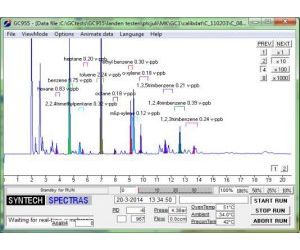
The components measured by the GC 955-811 analyser are predominantly emitted by the petrochemical industry either from refineries, evaporation during transport or incomplete burning. These light hydrocarbons are part of LNG and form the main compounds of LPG. Propane and Butane are also widely used for cooking. Ethene and isoprene are of biogenic origin.
The list contains one carcinogenic compound: butadiene. Some compounds can cause short term damage when inhaled and long term damage to liver or brain. But the function as ozone precursor for all compounds, except 1,3-butadiene, is the main reason for monitoring.
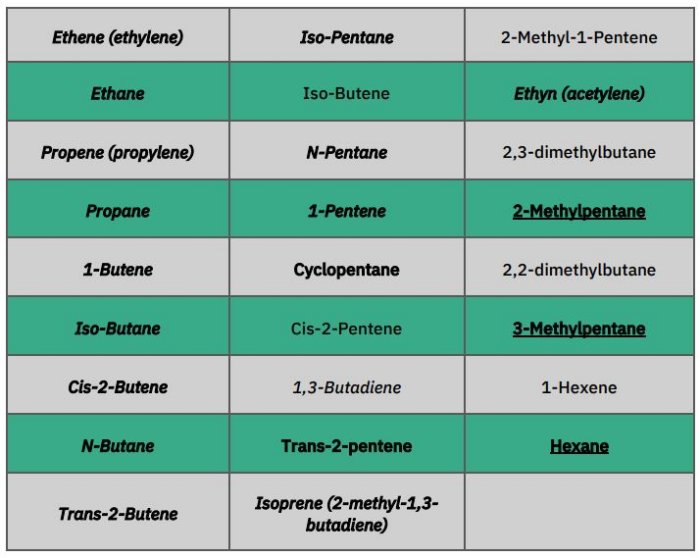
In the list below all USA EPA C2 to C5/C6 compounds are shown. The compounds also selected by the EU are marked in bold. Compounds that are underlined are also measured with the 611 system.
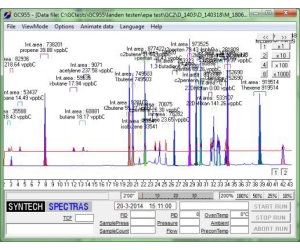
Online measurements show concentrations between detection limit (
The hydrocarbons are concentrated on a cooled trap inside the system. Two detectors are used: a photo ionization and a flame ionization. The unsaturated hydrocarbons on the list are detected by the PID, the saturated hydrocarbons are detected by the FID. This makes identification easy.
Sample humidity must be controlled preferably by using the Synspec SCU sample conditioning unit (see separate data sheet).
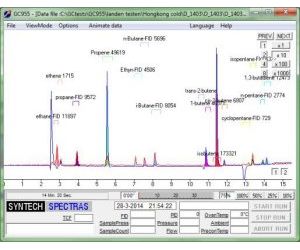
The system 611 is a gas chromatograph with a built-in pre-concentration system. Analysis is done by a photo ionization detector. This ensures high sensitivity and good identification. Optionally an FID can be included.
The system 811 is a gas chromatograph with a built-in cooled pre-concentration system. Analysis is done by a photo ionization detector and a flame ionization detector. This ensures high sensitivity and good identification. We advise to use the Synspec SCU sample conditioning unit to control the humidity of the sample.
A standard industrial PC with Windows Embedded is used. One PC can control both analysers. The user-friendly software stores all the chromatograms on the hard disk and data can be interpreted easily with the intuitive software. Data can also be transferred by network and modem connection. Besides this, analog and digital output options are available to communicate with other data logging systems using several data protocols.
Simple operation, good reliability and low maintenance costs are important to us. With a worldwide network of distributors you can rely on the instrument, with an individualized training and support available for you.
Preventive maintenance is only required once a year. For good quality data it is recommended to have a regular (automatic) calibration or validation. In the software an automatic multipoint validation /calibration is possible using calibration gas of one concentration per component.
The expected lifetime of the analyser is 10 years. Our warranty is 2 years; ask for maintenance requirements. Consumable part cost is low.
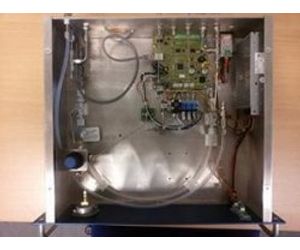
Synspec GC955 series 611 ozone precursor analyser
High boiling hydrocarbon fraction
TECHNICAL DESCRIPTION
- PID and optionally FID detector. Lowest detection level for benzene <0.4 μg/m3 (0.15 vppb).
- Please contact us for the lowest detection levels for the other components.
- Standard range: 0-30 ppb ( can be extended upon request).
REPRODUCIBILITY
- Typical <3% at 1 ppb (benzene, with capillary column)
GAS CONNECTIONS
- Instrument air: dry and clean, 3 bar, 250 ml/min (when optional FID is installed)
- Nitrogen, quality 5.0, 4 bar, 25 ml/min
- Hydrogen, quality 5.0, 3 bar, 20 ml/min
- Synspec GC955 series 811 ozone precursor analyser
- Low boiling hydrocarbon fraction
TECHNICAL DESCRIPTION
- PID and FID detector. Lowest detection level for 1-butene <0.4 μg/m3 . Please contact us for the lowest detection levels for the other components.
- Standard range: 0-30 ppb ( can be extended upon request).
REPRODUCIBILITY
- Typical <3% at 1 ppb (butane), with capillary column)
GAS CONNECTIONS
- Instrument air: dry and clean, 3 bar, 2 x 250 ml/min ( for FID and permapure dryers)
- Nitrogen, quality 5.0, 4 bar, 25 ml/min
- Hydrogen, quality 5.0, 3 bar, 20 ml/min
GENERAL CERTIFICATES
- CE approval for EMC conformity: EN 61000-6-2, EN 61000-6-3, EN 61010, EN 61326
STANDARD CALIBRATION
- Standard calibration provided for ozone precursors, UK NPL primary ozone precursor standard at 4 or 5 ppb as the USA Spectra Gases PAMS standard in the range 5-20 ppb.
DIMENSIONS
- 19” rack, 5 standard Height Units, depth 43 cm net
- (W 48,3 D 43 H 22 CM), WEIGHT 19 and 21 kg
HARDWARE
- Internal industrial x86 based computer, suitable for measuring and saving data up to 10 years. Hard disk, full color touchscreen, various data connection options.
INCLUDED SOFTWARE
- Windows embedded and GC955 software. Direct control via touchscreen, keyboard or mouse, via remote host (RS232/modem) or Ethernet.
- Software for running the analyser and demo version for data evaluation and reprocessing on desktop is included.
POWER DEMAND
- 230 V AC, 400 VA (115 V AC available), 50/60 HZ
OPTIONS
- Synspec Sample Conditioning Unit (SCU) with internal Perma Pure dryer, humidity sensor and switch between zero, span and sample for both analysers. This item is strongly recommended.