


- Home
- Companies
- DX Fluidics
- Products
- DX Fluidics - Syringe Pump
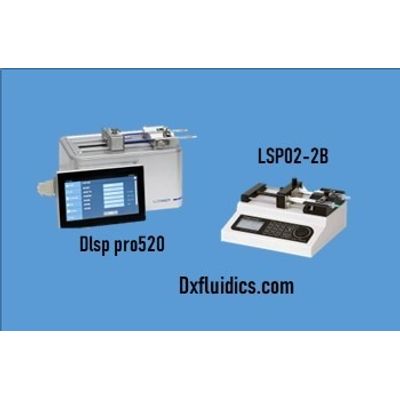
DX Fluidics - Syringe Pump
A syringe pump is a device for controlling precise liquid flow and flow rate based on a stepper motor as a drive source. It typically consists of a stepper motor, a pump head and a controller. The stepper motor provides precise speed and position control, the pump head is used to push the fluid into the line, and the controller controls the angle and speed of motor rotation.
- High-precision control: Stepper motors can very accurately control the angle of rotation and speed, thus realizing high-precision flow and flow rate control.
- Programmable control: The controller can be programmed to set the number of pulses and frequency of motor rotation, thus realizing different flow and flow rate control modes.
- Safe and reliable: stepper motor-driven syringe pumps usually have a variety of safety protection measures, such as overload protection, limit protection, etc., to ensure the safe and reliable operation of the equipment.
- Easy to operate: Stepper motor-driven syringe pumps usually have a friendly user interface and operating system, which is simple and convenient to operate.
- Wide range of applications: stepper motor-driven syringe pumps are suitable for a variety of experiments, production and testing occasions that require precise flow and flow rate control, such as microfluidics, biotechnology, chemical experiments and so on.
It should be noted that stepper motor-driven syringe pumps are more expensive compared to traditional syringe pumps, but in applications that require high-precision flow control, their accuracy and programmability advantages are significant, and they are widely used and recognized.
Syringe pumps are devices that can precisely control the flow of liquids, and therefore have a wide range of applications in the field of microfluidics. Microfluidics is a technology that utilizes micro-channels and micro-structures for fluid control and analysis, which is mainly applied in the fields of biomedicine, chemistry and material science. The following are applications of syringe pumps in the field of microfluidics:
- Pathogen detection: Syringe pumps can be used in microfluidic chips for liquid delivery, thus realizing pathogen detection. By controlling the flow rate and flow rate of the syringe pump, samples and reagents can be precisely mixed in the microfluidic chip, thus realizing the isolation and detection of pathogens.
- Drug screening: Syringe pumps can be used in microfluidic chips for drug delivery and distribution. By controlling the flow rate and flow rate of the syringe pump, the drugs and cells can be precisely mixed in the microfluidic chip, thus realizing the screening and evaluation of drugs.
- Cell culture: Syringe pumps can be used for cell culture in microfluidic chips. By controlling the flow rate and flow rate of the syringe pump, cell culture medium and nutrients can be precisely delivered in the microfluidic chip, thus realizing the culture and research of cells.
- DNA isolation and analysis: Syringe pumps can be used in microfluidic chips for DNA isolation and analysis. By controlling the flow rate and flow of the syringe pump, DNA samples and reagents can be precisely delivered in the microfluidic chip for DNA isolation and analysis.
- Protein analysis: Syringe pumps can be used in microfluidic chips for protein analysis. By controlling the flow rate and flow rate of the syringe pump, protein samples and reagents can be precisely delivered in the microfluidic chip, thus realizing the separation and analysis of proteins.