


- Home
- Companies
- Nanjing Tengda Machinery Equipment Co., ...
- Products
- TD - Steelwork Sludge Briquetting ...
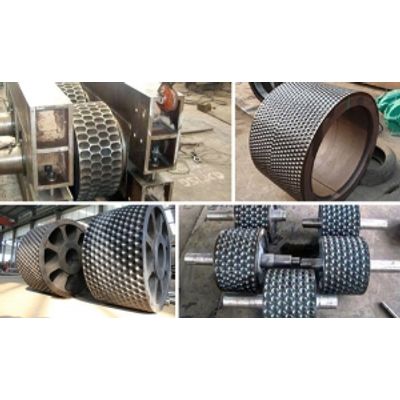
TD - Steelwork Sludge Briquetting Machine
This page relates to the making of composite briquettes of iron and steel plant wastes by cold briquetting process. It’s a process for cold briquetting of steel plant by-products such as iron ore fines, flue dust, mill scale, coke fines, steel slag and the like with an improved binder matrix, consisting of a combination of different in-organic binders, to make composite briquettes. The briquettes obtained have adequate green strength, cold-crushing strength and RDI and are suitable as blast furnace charge.
In the recovery of valuable by-products & wastes (flue dust, sludge, mill scale, steel slag) produced in steel making process, integrated steel plant could press grain particles into briquettes with the addition of binder under high mechanical pressure. With the help of roller briquetting machine, in-plant recycling and zero-emission is available.
Steelwork sludge briquetting machine could process these iron-containing materials into dense, strong, cold-bonded briquettes, which is charged into blast furnace again. In the production of DRI (direct reduced iron, namely sponge iron), blast furnace sludge, converter furnace sludge, basic oxygen furnace sludge could act as ingredient, together with mill scale and flue dust at some ratio. It’s the HBI, hot briquetted iron.
Certain binder, usually molasses, hydrated lime, bentonite or water glass, is necessary to increase the mechanical linkage between particles. Thus, briquettes will be stronger. And further drying treatment is applied to finish curing stage before using. Exposed to the air for 24-48 hours, briquettes with 2.5% moisture content is suitable for further process.
It has been found that the room-temperature properties of briquettes depend upon various processing parameters like solid/water ratio, vibration time, briquetting force, compression time and particle size distribution of the raw material. The optimum values of these are interrelated and depend upon the composition of the briquettes.
The application of briquetting technology:
- Ore: iron ore fines, chrome ore fines, chromite ore fines, laterite ore fines, manganese ore fines, nickel ore fines, magnesite
- Fuel: charcoal powder, coal fines, carbon black, petroleum coke, coke
- Mineral: quick lime, burnt lime, gypsum, fluorite, fluorspar, iron concentrate, clay
- By-products in metallurgy: refractory materials, silicon carbide, aluminum dross, residues
- By-products in steel making: sponge iron, mill scale, iron dust, flue dust, steel sludge, fly ash, sintering fines