


- Home
- Companies
- C-Therm Technologies Ltd.
- Products
- C-Therm - Transient Line Source (TLS) ...
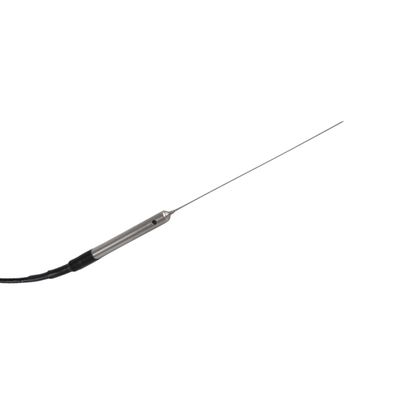
C-Therm - Transient Line Source (TLS) Needle
The TLS method employs a needle probe to characterize the thermal conductivity of viscous and granular materials. It is the most robust sensor for thermal conductivity testing.
Check the full content and details here.
The Transient Line Source (TLS) technique operates in accordance with ASTM D5334, D5930 and IEEE Std 442-1981. Commonly referred to as needle probes, The TLS sensors provide a robust and efficient solution for measuring the thermal conductivity of granular materials, powders, polymer melts, soils, slurries, gels, and pastes.
This technique involves placing an electrically heated needle into a material. The heat flows out radially from the needle into the sample. During heating, the temperature difference between a thermocouple (T1) positioned in the middle of the heating wire, and a second thermocouple (T2) located at the tip of the needle is measured. By plotting this temperature difference versus the logarithm of time, thermal conductivity can be calculated. Typically, the measurement is on the order of 2-10 minutes.
- An internal platinum wire is heated electrically - providing a known amount of heat per unit length.
- The temperatures are measured at locations T1 (located in the middle of heating wire) and T2 (located at the tip of the needle).
- The rate of increase in temperature as a function of logarithmic time is then used to calculate the thermal conductivity of the sample. The slope of the line is inversely proportional to the thermal conductivity of the sample. The temperature will rise more steeply when lower thermal conductivity materials (e.g. powders) are tested.