


- Home
- Companies
- LabLogic Systems Limited
- Products
- Tri-Sorber - Tritiation Manifold
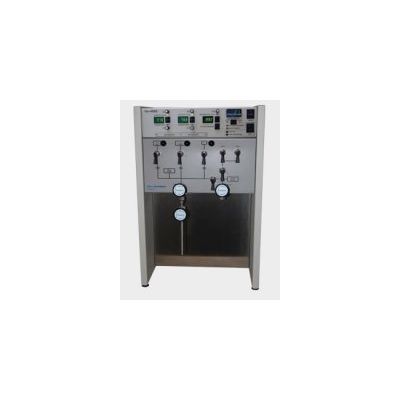
Tri-Sorber - Tritiation Manifold
With increasing interest in high specific activity tritium labeling, there has been a corresponding interest in improved tritium handling. It has long been known that large amounts of tritium may be sequestered on uranium metal and released from it as needed by controlled heating. The TRI-SORBER is the first completely self-contained commercial realization of this proven principal. The key to the operation of the TRI-SORBER is facile and quantitative reversible formation and thermal decomposition of uranium tritide, UT3. At 250-300oC, depleted uranium, 238U, in the presence of T2, is rapidly converted to the tritide. In turn, the tritide may be decomposed back to the metal and tritium gas by further heating. Once UT3 has formed and decomposed, thereby reducing the size of the metal particles from -60 mesh to 1 micron or less, the resultant powdered uranium will then react with T2 at room temperature.
Uranium has a remarkable capacity for tritium; with 100% enriched T2, the tritide formed from 1 g of metal has a tritium activity level of 363 Ci. With uranium metal having a density of 19.05, and that of UT3 being near 11, more tritium can be stored on uranium at atmospheric pressure and room temperature than can be stored in the same volume as a liquid. Nor is storage of tritium gas under pressure as convenient; to store one mol of T2 in a 100 cc cylinder requires a pressure of 3350 psi at room temperature. In contrast, that same quantity of gas is stored as UT3 at room temperature and atmospheric pressure in a volume of less than 20 cc.
The TRI-SORBER manifold is entirely of stainless steel with fixed elements interconnected via orbital butt welding. Face-seal vacuum couplings are employed where sections may be usefully taken apart. Packingless high vacuum bellows valves are used throughout. Sensors continuously monitor temperature and pressure; automatic cut-outs prevent exceeding safe limits. The vacuum pump incorporates an automatic shut-off valve which isolates the system when not in service.
Operation is straightforward. After an initial heat activation under vacuum, T2 is admitted to one of the three uranium beds where the gas is taken up with remarkable rapidity, forming UT3. With tritium available, the reaction flask is put in place and evacuated. 3He, the decay product of tritium during storage, is pumped off. By controlled heating of the storage bed and monitoring the gas pressure, a measured amount of T2 is delivered to the reaction flask and the flask is closed off. T2 that does not enter the reaction flask is quickly reabsorbed in the primary storage bed by permitting the bed to cool. The tritiation reaction is allowed to take place and then any unreacted T2 in the reaction flask is collected in a second uranium bed reserved for waste. Still a third bed is available to store deuterium for pilot studies.