

Triton - Desalination Plants
We make six different desalination plants with capacities ranging from 5 to 1,000 cubic meters per day. Each plant is designed for the customer’s water source, discharge requirements, and the water-quality and -quantity needs. Depending on local, environmental, and customer requirements, we also offer Triton built, owned, and operated plants, or BOO plants. The customer simply rents the plant by paying for each cubic meter of desalinated water, eliminating both capital expenses and maintenance costs.
> SEARO-10 ERS (100 M3/DAY)
100,000 liters per day / 26,417 gallons
> SEARO-20 ERS (250 M3/DAY)
250,000 liters per day / 66,043 gallons
> SEARO-25 ERS (300 M3/DAY)
300,000 liters per day / 79,251 gallons
> SEARO-42 ERS (500 M3/DAY)
500,000 liters per day / 132,086 gallons
> SEARO-84 ERS (1000 M3/DAY)
1,000,000 liters per day / 264,172 gallons
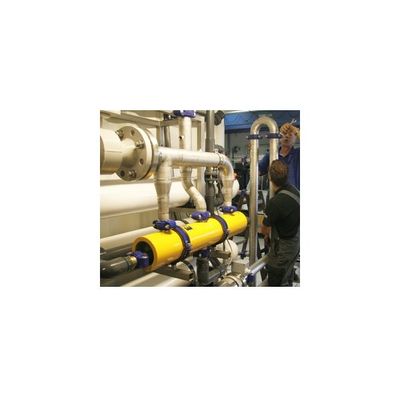
Triton’s energy recovery device dramatically reduces the amount of energy required to desalinate water.
HOW DO OUR PLANTS WORK?
Triton desalination plants use high-pressure reverse osmosis, or RO technology, to remove the salt from seawater:
- In RO, seawater is pushed through a membrane, which blocks salts and undesirable chemicals but allows water molecules to flow through.
- The salt is discharged in a highly concentrated stream of brine at a high level of pressure.
- An energy recovery system uses the high pressure of the outgoing brine to increase the pressure of the incoming seawater.
- The result is a dramatic decrease in the energy required to desalinate water.
THE ENERGY RECOVERY DEVICE
The Triton’s energy recovery system uses only a single moving part, requiring little if any maintenance over the life of the plant.
And Triton’s three-layer membranes are continuously updated and refined to perform as effectively as possible. New membranes currently under development are expected to lower the pressure requirements to obtain the same desalination quality—even further reducing our plants’ carbon footprint.
Triton’s reverse osmosis plants offer significant advantages over thermal desalination and large industrial desalinators.
A PROVEN TECHNOLOGY
PORTABILITY
Triton’s plants are housed in standard shipping containers and can be transported wherever needed.
NO CIVIL INFRASTRUCTURE
All the Triton customer needs is electricity, sea water, space for a freshwater tank, and a discharge pipe to the sea.
LOW ENERGY COSTS
Triton has led the market in crucial technological innovations that have lowered energy consumption by 97%.
LOW MAINTENANCE COSTS
Triton’s plants use less pressure than the plants of many other companies, so they experience less wear—which means less maintenance and repair.
PLANT RENTAL
For customers who don’t wish to purchase a plant, Triton rents plants according to the volume of water desired. Large suppliers offer these contracts, too—but Triton’s small and mid-sized plants cost far less and require far shorter lead times.
FAST, EASY INSTALLATION
Triton’s plants are up and running within 2-3 days.
EASY UPGRADES
Triton plants are easily upgradeable with new components. That keeps plants efficient and protects capital expenditures.
LOWER ENVIRONMENTAL IMPACT
Large plants discharge large quantities of brine that negatively impact sea life. Triton’s plants discharge a nominal amount of brine, with no known impact.
PROTECT COASTAL VIEWS
Large plants are an eyesore, disrupting coastal views. Triton plants can be stored in maintenance areas such as near a building’s exterior HVAC, refuse, etc.
WATER DISTRIBUTION
On a small island, Triton can install several small plants in different locations, preventing the necessity for long distribution networks.