


- Home
- Companies
- NexSens Technology, Inc
- Products
- NexSens - Model NX260 - Turbidity ...
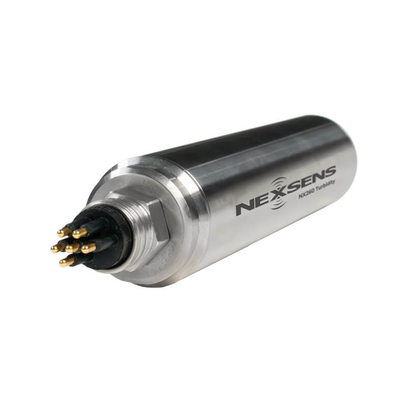
NexSens - Model NX260 -Turbidity Sensor
The NexSens NX260 Turbidity Sensor is designed for long-term monitoring with a built-in wiper, titanium body, and low power consumption.
The NX260 is designed to perform in fresh, brackish, and saltwater environments. Corrosion-resistant titanium construction and a marine-rated connector ensure reliable performance in the toughest conditions.
Internal optics transmit and receive signals through a scratch-resistant sapphire lens, and a replaceable wiper keeps the sensor clean for accurate measurements and extended deployments.
The NX260 is ready to go right out of the box—no wiring or programming is needed when used with NexSens data loggers. Setup is quick with the NexSens CONNECT software, making it easy to calibrate, adjust settings and start collecting data in minutes.
It connects to other data loggers using standard RS-485 Modbus RTU protocol or by SDI-12 with an optional adapter.
With a range of 0 to 1000 FNU, the NX260 delivers high-quality turbidity measurements with accuracy and repeatable precision.
Adhering to ISO 7027 standard for nephelometric turbidity measurement, the sensor uses an infrared LED source at 860 nm and measures particle (sediment) scattered light at 90-degrees to determine turbidity.
Microprocessor-based electronics include signal processing, temperature compensation, and wiper control. It includes a light source, a photodetector, and optical filters.
Onboard memory stores calibration constants, and the sensor outputs turbidity data in FNU (Formazin Nephelometric Units). The electronic circuits are designed with ultra-low power consumption, making it ideal for battery and solar-powered applications.
NexSens CONNECT software facilitates calibration in both the lab and the field. The interface offers one, two, or three-point calibrations.
Formazin standards are stable and have a uniform particle size, making them suitable for calibration or verification. It provides reproducible measurements and ensures quality data.