


- Home
- Companies
- EE-water, Brand of Shenzhen Essential ...
- Products
- EE-water - Turbidity Sensor for Water ...
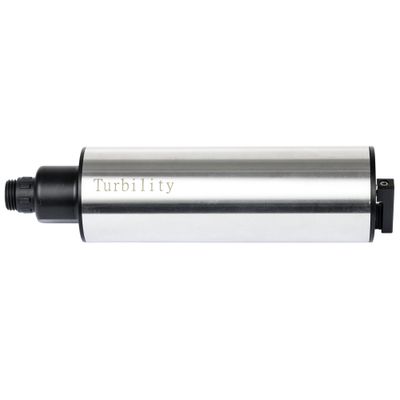
EE-water - Turbidity Sensor for Water Quality Monitoring
Turbidity sensors operate on the principle of 90° scattered light detection, offering a comprehensive solution for turbidity measurement. They are especially advantageous due to their wide measurement range and self-cleaning features, making them maintenance-free. These sensors are adept at measuring turbidity in various settings, including backwash water in filter tanks at treatment plants, raw water, effluent from sedimentation tanks, and during industrial production processes. The sensors are also applicable for routine monitoring of surface water, groundwater, and pipeline networks. They reduce microbial contamination due to a self-cleaning window coating and feature LED emissions at 880 nm to negate color interference. Designed for continuous monitoring, they promise rapid response times (<10s), and offer flexible installation (immersion or pipeline). Operating within a wide temperature range (0-50°C), they communicate via RS485 Modbus Protocol and are powered by DC 12-24V.
The turbidity sensor uses the principle of 90° scattered light detection, featuring advantages such as large measurement range, self-cleaning, and maintenance-free operation. It can be applied to turbidity measurement of backwash water in filter tanks at water treatment plants, measurements of turbidity in raw water and effluent from sedimentation tanks; monitoring water quality during industrial production processes; as well as routine water quality monitoring of surface water, groundwater, and pipeline networks.
- Self-cleaning window coating reduces microbial contamination;
- Designed with a self-cleaning wiper for secondary cleaning of the window surface;
- The LED emits 880 nm near-infrared light, which compensates for sample color interference;
- Continuous measurement with fast response, suitable for continuous monitoring and control;
- Large measurement range with multiple selectable ranges to meet accuracy requirements for different applications;
- Flexible installation methods, simple and easy to implement.