New Era Pump Systems, Inc.
- Home
- Companies
- New Era Pump Systems, Inc.
- Products
- New-Era - Model NE-4000 - Two Channel ...
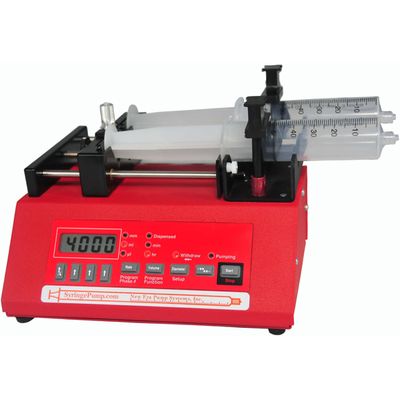
New-Era - Model NE-4000 -Two Channel Programmable Syringe Pump
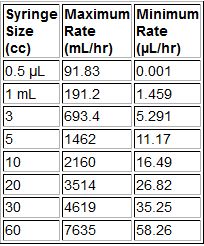
Holds 2 Syringes up to 60 mL each, can be different sizes. Both syringes operate in sync. Independent syringe operation, including "Push-Pull", available with the Dual Pump System. Infusion rates from 1.436 µL/hr (1 mL syringe) to 7515 mL/hr (60 mL syringe).
Most popular related searches
programmable syringe pump
syringe pump
pump system
microfluidic
laboratory productivity
laboratory product
laboratory benching
laboratory bench
glass disposal
monitoring pump
- Easy-to-use keypad interface
- One-click program upload from "Pumping Program Generator" spreadsheet
- Space Saving Chassis: Foot print size of only 5 3/4" x 8 3/4"
Won`t take up unnecessary space on your laboratory or production bench - Includes all the advanced functions and programming features of the NE-1000 series
- Disposable, Glass, Stainless Steel Syringes and Plumbing Supplies are sold separately.
- Download Brochure
- Download User Manual
- Available in Microfluidics (NE-4002X) and OEM (NE-4500) versions
Special Application: Continuous Infusion (Push-Pull) and Dual Syringe Pump
Using 2 NE-4000 pumps attached with a cable, one pump will infuse while the other pump refills or have simultaneous infusion.
- Fully programmable; automation capable
- Operates stand-alone or from a computer
- Infusion and withdrawal
- Available in Microfluidics (NE-4002X) and OEM (NE-4500) versions
- Set a single pumping rate and/or dispensing volume
- Program up to 41 pumping phases that change pumping rates, set dispensing volumes, insert pauses, control and respond to external signals, sound the buzzer
- Network, control, and monitor up to 100 pumps with one computer
- Worldwide power supplies available
- Motor stall detection
- Dispensing accuracy of +/-1%
- Unlimited lifetime technical support
- Two year warranty
The NE-4000 produces about 15 lbs(7.5 lbs/syringe) of linear force at top speed and about 100 lbs(50 lbs/syringe) at slow speeds. 10 ml/hr is an example of slow speed. The pressure that can be generated is relative to the syringe size. On a 60 ml syringe, this would roughly produce about 30 psi.