


- Home
- Companies
- Taian Demei Electromechanical Equipment ...
- Products
- D-MEI - Model DY-HT1D - Ultra-low ...
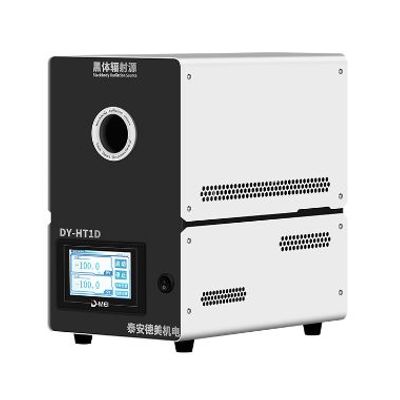
D-MEI - Model DY-HT1D -Ultra-low Temperature Blackbody Furnace (-100℃~80℃)
The DY-HT1D Ultra-low Temperature Blackbody Furnace operates within a temperature range of -100°C to 80°C. It serves as a standard radiation source for calibrating radiation thermometers, infrared thermometers, and radiation temperature sensing detectors. Its compact, lightweight design makes it portable, suitable for both laboratory and on-site calibration. The device supports seamless human-machine interaction with a user-friendly Chinese touch interface, allowing one-key temperature settings and rapid heating control. Designed with an isothermal black body cavity, the furnace offers high emissivity and excellent temperature stability. It incorporates a cavity diameter of 50 mm with emissivity above 0.995 and a temperature resolution of 0.1°C. Featuring a PID automatic control system, it ensures reliable and efficient operation with a power supply of 220 VAC at 50 Hz and a power rating of 1600 W. The unit measures 610 x 280 x 410 mm and weighs 20 kg, and it does not require a high-power transformer due to its special pressure limiting heating software. Customization options are available upon request.
The temperature range of the blackbody furnace is -100℃~80℃.Blackbody radiation source, mainly used for calibrating radiation thermometers, infrared thermometers and radiation temperature sensing detectors.
The product is small in size, light in weight and easy to carry. It is not only suitable for the use of radiation thermometers in the laboratory calibration of measuring institutions at all levels, but also for on-site calibration.
Product Introduction of Blackbody Temperature Calibrator
In the calibration and verification of radiation thermometers, the comparative method is usually adopted, that is, through the radiation source of high stability (usually black body radiation source) and other supporting equipment, the temperature reproduced by the standard apparatus and the temperature reproduced by the radiation thermometer are compared, in order to judge whether it is qualified or to give the calibration results.
As a standard radiation source, the standard black body is mainly used to calibrate radiation thermometers, infrared thermometers and radiation temperature sensing detectors.
At present, our company has advanced black body technology, full product range and wide temperature range of black body series products.
Product Feature of Blackbody Radiation Source
- Human-machine interface, Chinese display, touch operation, beautiful and generous.
- One-key temperature setting, easy to operate.
- Rapid heating, temperature control.
- Novel appearance design, the use of furnace body and temperature control instrument separated structure.
- Isothermal black body cavity, only one cavity mouth, cavity mouth radiation evenly distributed along with the spectrum, cavity mouth emissivity above 0.995, the resolution of 0.1.
- Heat insulation between the heating body and the shell, special software is used for pressure limiting heating, no high-power power transformer is required.
- Automatic temperature control is adopted, which is safe and reliable with fast temperature rise and good temperature stability.
- Easy to operate, small in size and light in weight, easy to carry, suitable not only for laboratory calibration, but also for on-site calibration.
- Operating temperature: -100℃~80℃
- Operation mode: touch screen operation
- Temperature resolution: 0.1℃
- Temperature control: PID automatic control
- Mouth cavity diameter: Φ 50 mm
- Cavity and mouth emissivity: ≥0.995
- Temperature stability: t is the radiation source temperature if the temperature is not greater than 0.1℃ and 0.1% T
- Temperature uniformity: not greater than ± (0.15℃ and 0.15% T, t is the radiation source temperature)
- Power supply: 220 vac50hz
- Power: 1600 w
- Size: 610*280*410mm(length x width x height)
- Weight: 20 kg
- Note: other special requirements can be customized according to the needs of users