
- Home
- Companies
- FiRa Consortium, Inc.
- Products
- FiRa Consortium - Ultra-Wideband (UWB) ...
FiRa Consortium - Ultra-Wideband (UWB) Technology
In challenging environments, such as parking structures, hospitals, airports and high density venues, ultra-wideband (UWB) technology outperforms other technologies in terms of accuracy, power consumption, robustness in wireless connectivity, and security, by a wide margin. UWB securely determines the relative position of peer devices with a very high degree of accuracy and can operate with line of sight at up to 200 meters. In contrast to narrow band wireless technologies, the use of wide bandwidth means UWB provides very stable connectivity, with little to no interference and offers highly precise positioning, even in congested multi-path signal environments.
By calculating precise location, fine ranging based on UWB is a more secure approach to closing and opening locks, whether those locks are installed on a car door, a warehouse entryway, a conference room, or your front door.
The History of UWB Within IEEE 802
UWB previously served as a technology for high data-rate communication and as such was in direct competition with Wi-Fi. Since then, UWB has undergone several transformations:
- UWB has evolved from an OFDM-based data communication to an impulse radio technology specified in IEEE 802.15.4a (2ns pulse width); and
- A security extension is currently being specified in IEEE 802.15.4z (at the PHY/MAC level), making it a unique and secure fine ranging technology.
Moving from data communication to secure ranging allows the spatial context capability to be utilized by a variety of applications, including hands-free access control, location-based services, and device-to-device (peer-to-peer) services.
Building on the IEEE Foundation
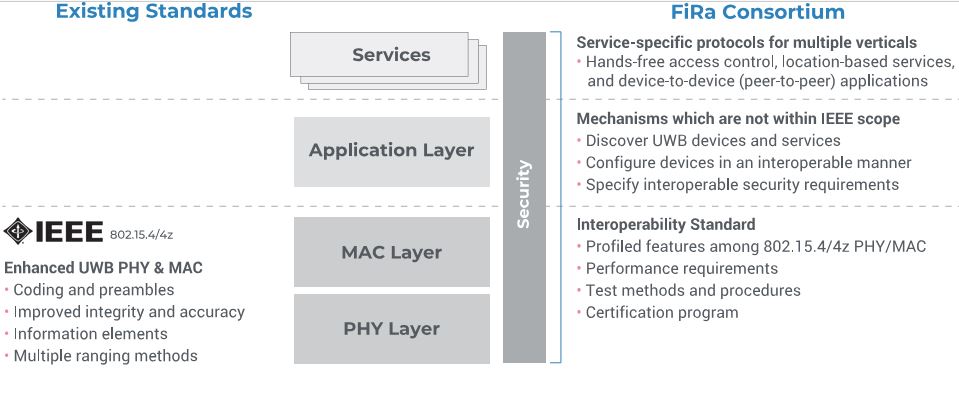
The starting point for UWB technology is the IEEE standard 802.15.4 and the IEEE 802.15.4z-2020 Amendment 1. This Amendment 1 is the IEEE standard for low-rate wireless networks that covers enhanced ultra-wideband (UWB) physical layers (PHYs) and associated ranging techniques. The 802.15.4 standard is widely used in a variety of applications that use ranging capabilities, such as High Rate PHY (HRP) and Low Rate PHY (LRP). In general, the IEEE 802.15.4 standard defines the PHY, MAC, and sublayers, with a focus on low-data-rate wireless connectivity and precision ranging. Different PHYs are defined for devices operating in various license-free brands in various geographic regions.
In January 2018, in response to demand for enhanced operation, the 802.15.4z task group was established to define the PHY and MAC layers for HRP and LRP. IEEE 802.15.4z is focusing on additional coding and preamble options, as well as improvements to existing modulations to increase the integrity and accuracy of ranging measurements, with a typical range of up 200 meters for the radio. Definition of an element that supports additional information will facilitate the exchange of ranging information.
It is the aim of the FiRa Consortium to build on what the IEEE has already established for HRP. That means supporting the IEEE’s work with an interoperable HRP standard that includes performance requirements, test methods and procedures, and a certification program based on the IEEE’s profiled features. It also means defining mechanisms which are out of scope of the IEEE standard, including an application layer, which discovers UWB devices and services and configures them in an interoperable manner. We are also pursuing a number of other activities, such as developing service-specific protocols for multiple verticals and defining the necessary parameters for a range of applications, including physical access control, location-based services, device-to-device services, and many more.
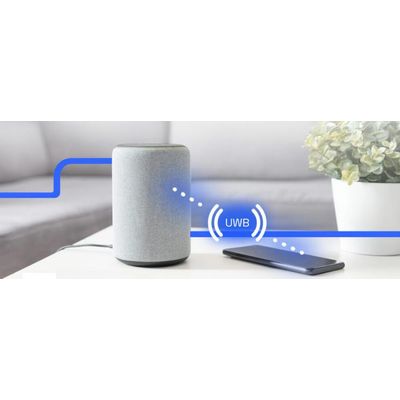
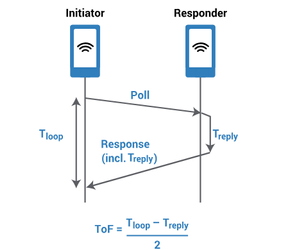
The operating concept is simple. Once a device that is equipped with a ultra-wideband (UWB) radio such as a smartphone, wristband, or smart key comes into range of another UWB device, the devices start ranging. The ranging is done by performing Time of Flight (ToF) measurements between the devices. The TOF is calculated by measuring the roundtrip time of challenge/response packets. Depending on the type of the application (e.g. in case of asset tracking, device localization), either the mobile or the fixed UWB device calculates the precise location of the device. In the case where the device is running an indoor navigation service, it is required to know its relative location to the fixed UWB anchors and calculate its position on the area map.
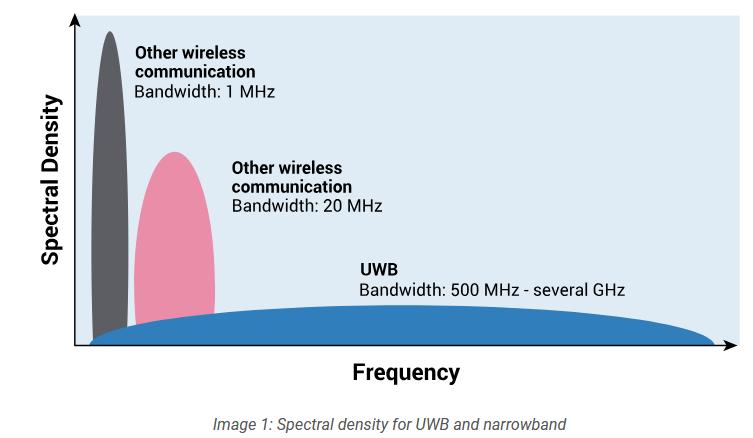
UWB uses very large channel bandwidth (500 MHz) with short pulses of about 2 ns each; this helps achieve centimeter accuracy. The UWB positioning process happens in an instant, so the mobile device’s movements can be tracked very accurately in real time.
The FiRa Consortium supports the 500 MHz band in the Channel 5 to Channel 14 range. As Channel 9 offers the greatest worldwide regulatory acceptance, it is the only channel for which support is considered to be mandatory across FiRa Certified™ devices.
UWB-Enabled Devices Understand Motion and Relative Position
The real-time accuracy of UWB measurements means a UWB-enabled system can know, with a very high degree of certainty, the precise location of a device and whether it’s stationary or moving toward or away from a given object. For example, a UWB-enabled system can sense if you’re moving toward a locked door and it can know if you’re on the inside or outside of the doorway, to determine if the lock should remain closed or open when you reach a certain point.
The precise accuracy of UWB ranging allows the use cases to define the exact intent range to avoid false triggering. For example, if you live in a house with an attached garage, the UWB-enabled system can be configured to know when your car approaches that it is time to open the garage door so you can park your car when you come home from shopping. Or that it is time to unlock the entryway from the garage to the kitchen so you can bring in your groceries.
UWB Delivers Higher Security
Today’s technologies for ranging primarily rely on signal strength to determine distance and location. They measure the device’s signal strength and assume a strong signal means the device is close by. Attackers have found a way to trick these systems, using what’s called a relay station attack. In this type of attack, the legitimate wireless signals used to unlock a door are intercepted and amplified, causing the door to open even though the key isn’t close by.
What’s missing in these approaches is the precise calculation of actual physical distance, and this is exactly what UWB brings to the application. With UWB, any attempt to intercept and amplify the signal, during a relay attack, will only delay the arrival of the responding device’s acknowledgement signal, making it clear to the UWB-based lock that the responding device is actually farther away, not closer. Any UWB signal that attackers succeed in intercepting and boosting won’t trick a UWB-equipped lock into opening. Moreover, the extension of IEEE 802.15.4z adds PHY level protection to all known attacks on legacy UWB radio.
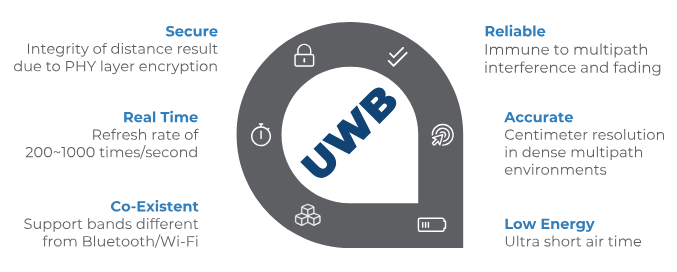
The wireless connectivity technology industry has grown so huge that it can be challenging to put new entrants into perspective. While Bluetooth® Low Energy and Wi-Fi already benefit from a very broad market adoption today, they lack in accuracy when it comes to their positioning capabilities and provide relatively little to no RF level security, compared to ultra-wideband (UWB), to protect ranging data exchange. Here are the key advantages UWB has over other positioning technologies: